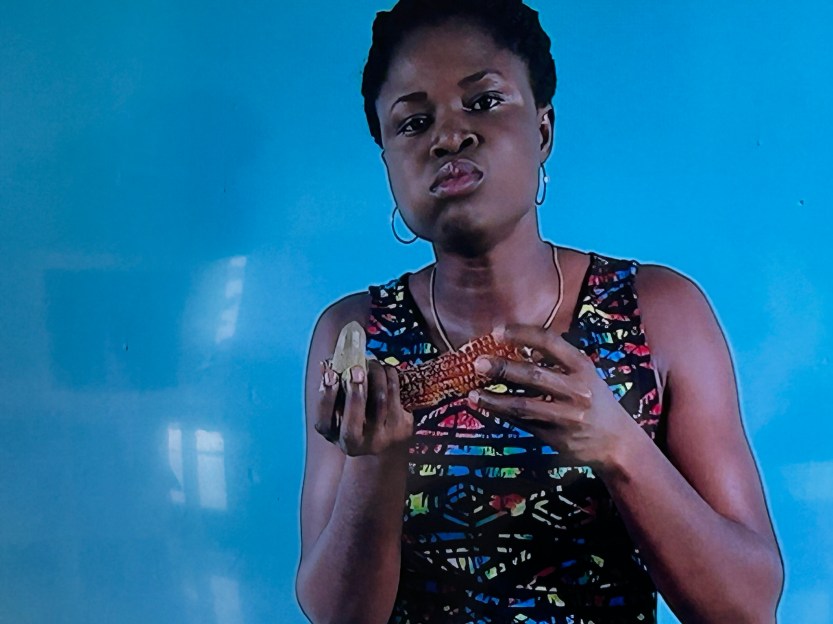
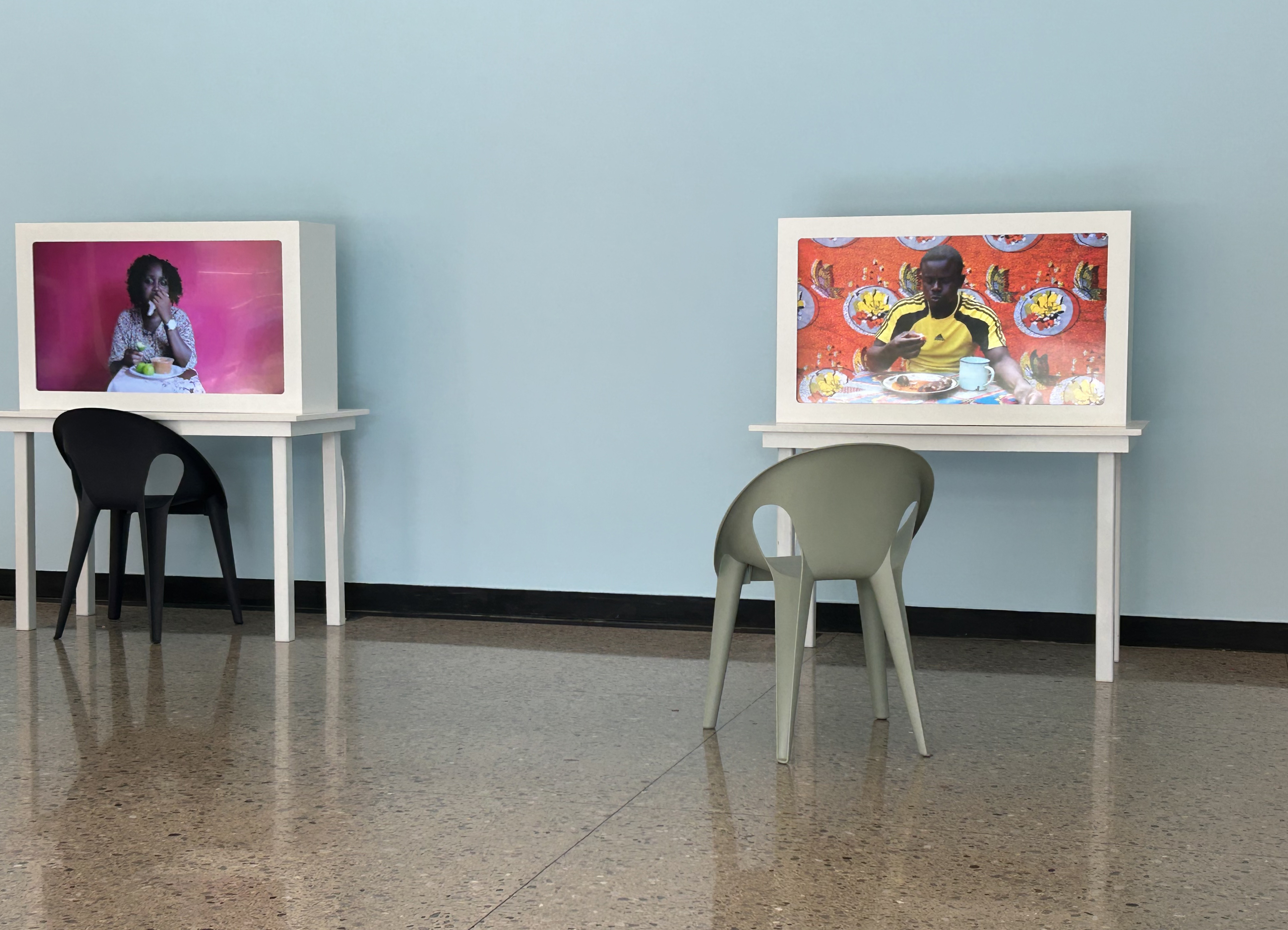
The screen is meant to be a portal. It never quite becomes one, but the presence of that intention lingers. There are eight screens, in fact, not just one, set up at the perimeters of a room in heavy white boxes. Moulded plastic chairs are haphazardly shoved in front of them or around tables at the centre of the room. When my mother and I arrive, most are empty. They feel like place holders.
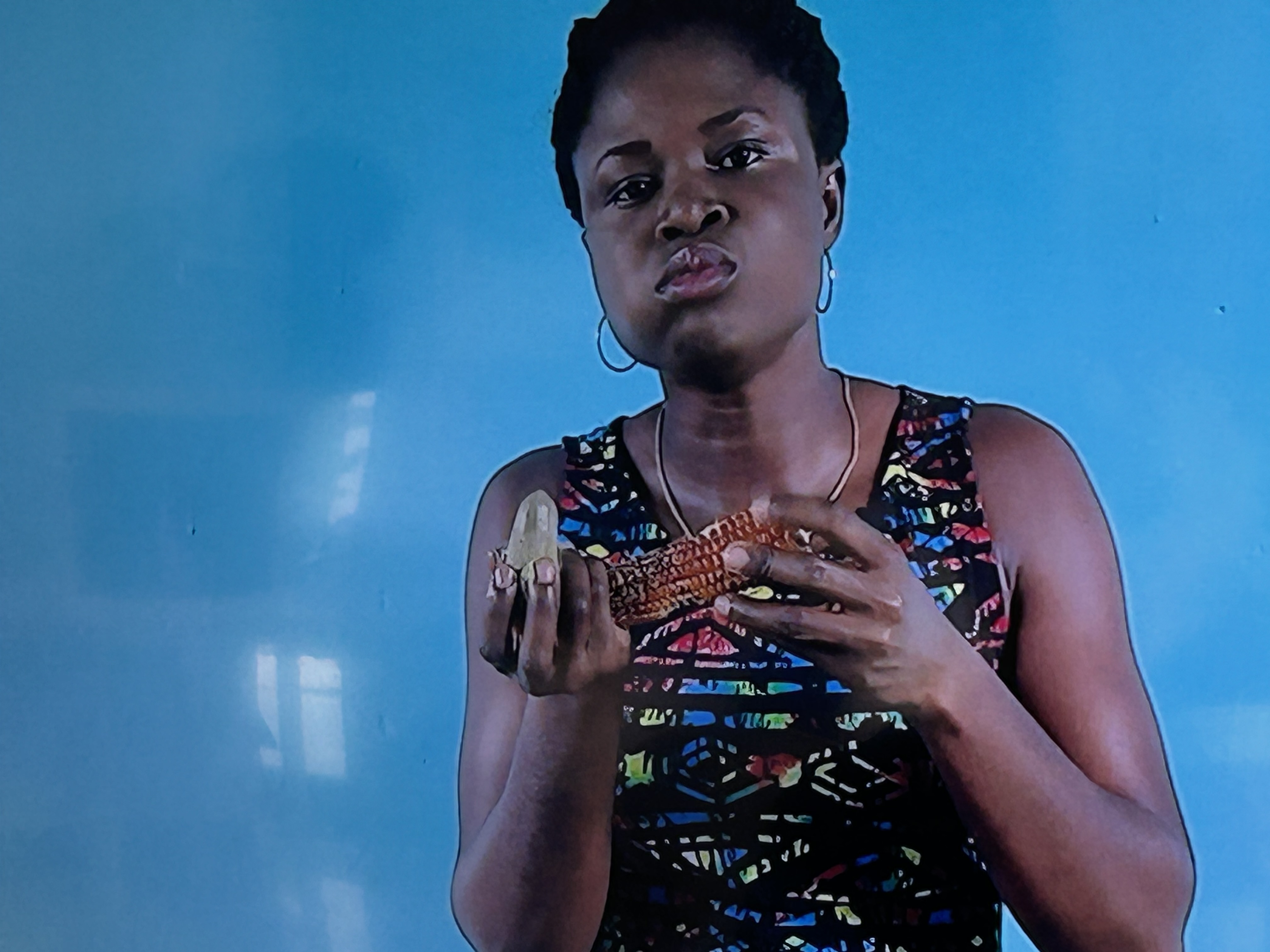
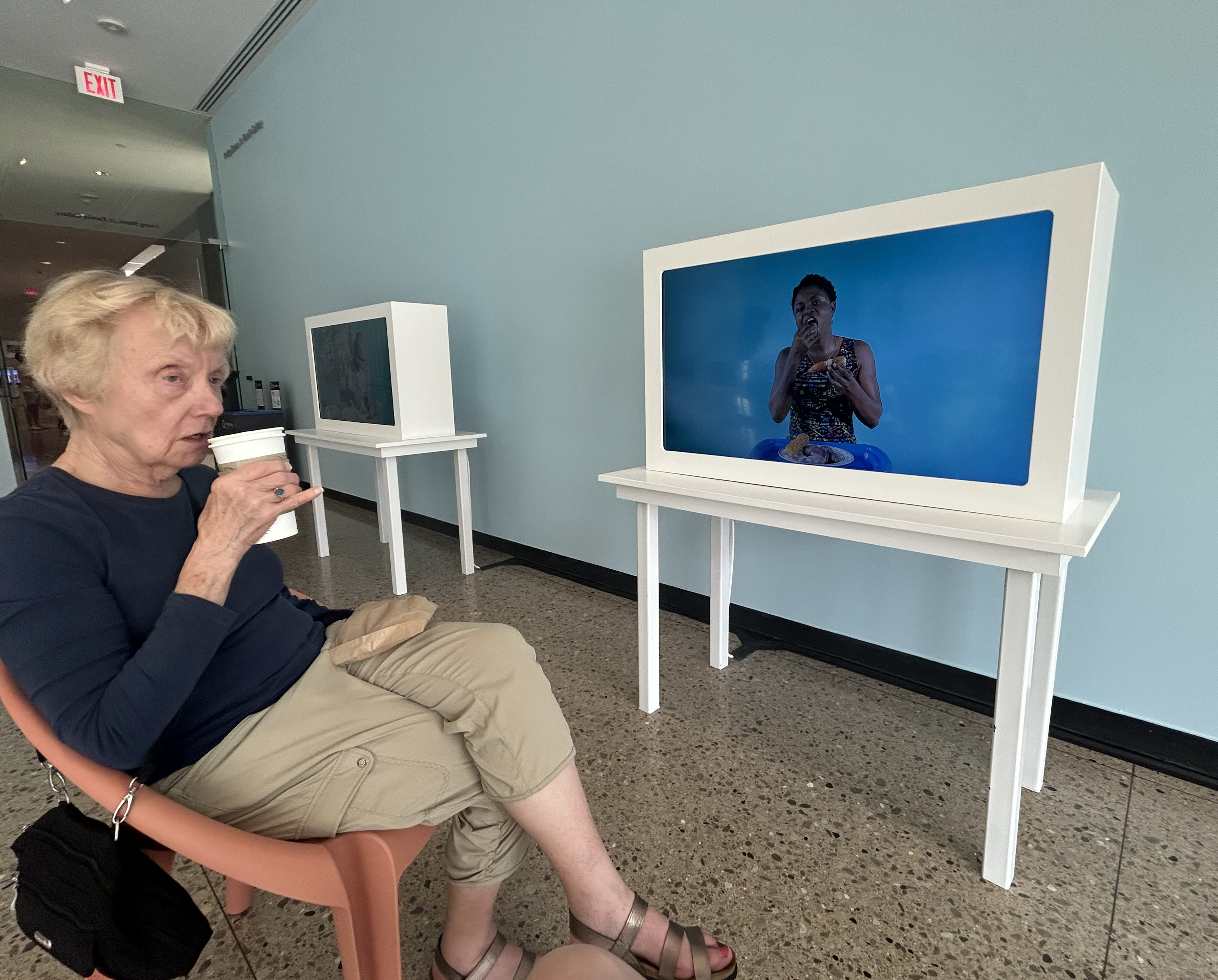
We sit down with our turmeric tea and with Lewa, who is eating roasted corn and boiled pears. She appears on our screen against a deep Vanadyl blue (it’s the kind of saturated blue that doesn’t have an easy analogue in nature; the hex code is #009EDF). The blue does two important things: it surrounds Lewa in a way that makes her seem as if she is in a virtual non-place (an undisguised green screen); it brings into focus her brightly coloured batik cotton shirt, and especially, the food that returns her to place (to Rumuibekwe Estate, Port Harcourt, Nigeria, where she was filmed).
Lewa tilts her head to her left, eyes never leaving the camera lens. We sit together, and at a distance, mostly in silence, while I watch her eat, and reflect on the title of the installation. “I called it ‘Table Manners’; People think it’s about manners, it’s actually not,” Saro-Wiwa said. “It’s about place. Because at the end of each film, I say where it’s taken place, and I’m forcing you to ingest, when you’re watching someone eat, there’s a powerful exchange that happens.”
So, it’s about manners in the sense of coping with the awkwardness imposed on us by the way we encounter and perceive each other from our grounded places in the world. It’s not manners in the narrow North American sense of sitting up straight, keeping your feet on the floor, and holding your food or dining ware in a particular way. Though to be sure, there is something bodily about this shared meal. Lewa bites into the dark purple skin of the pear and we sip our tea.
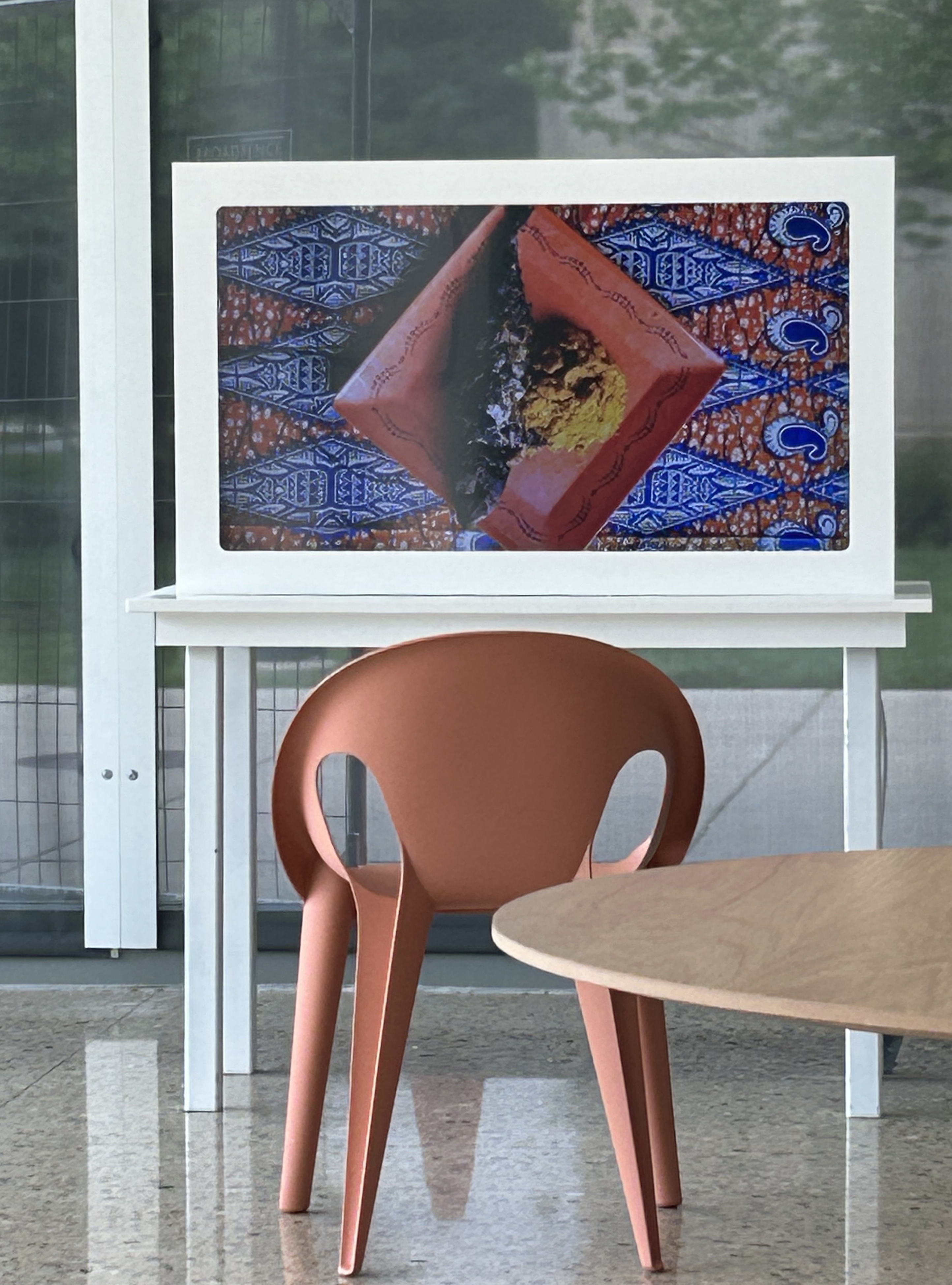
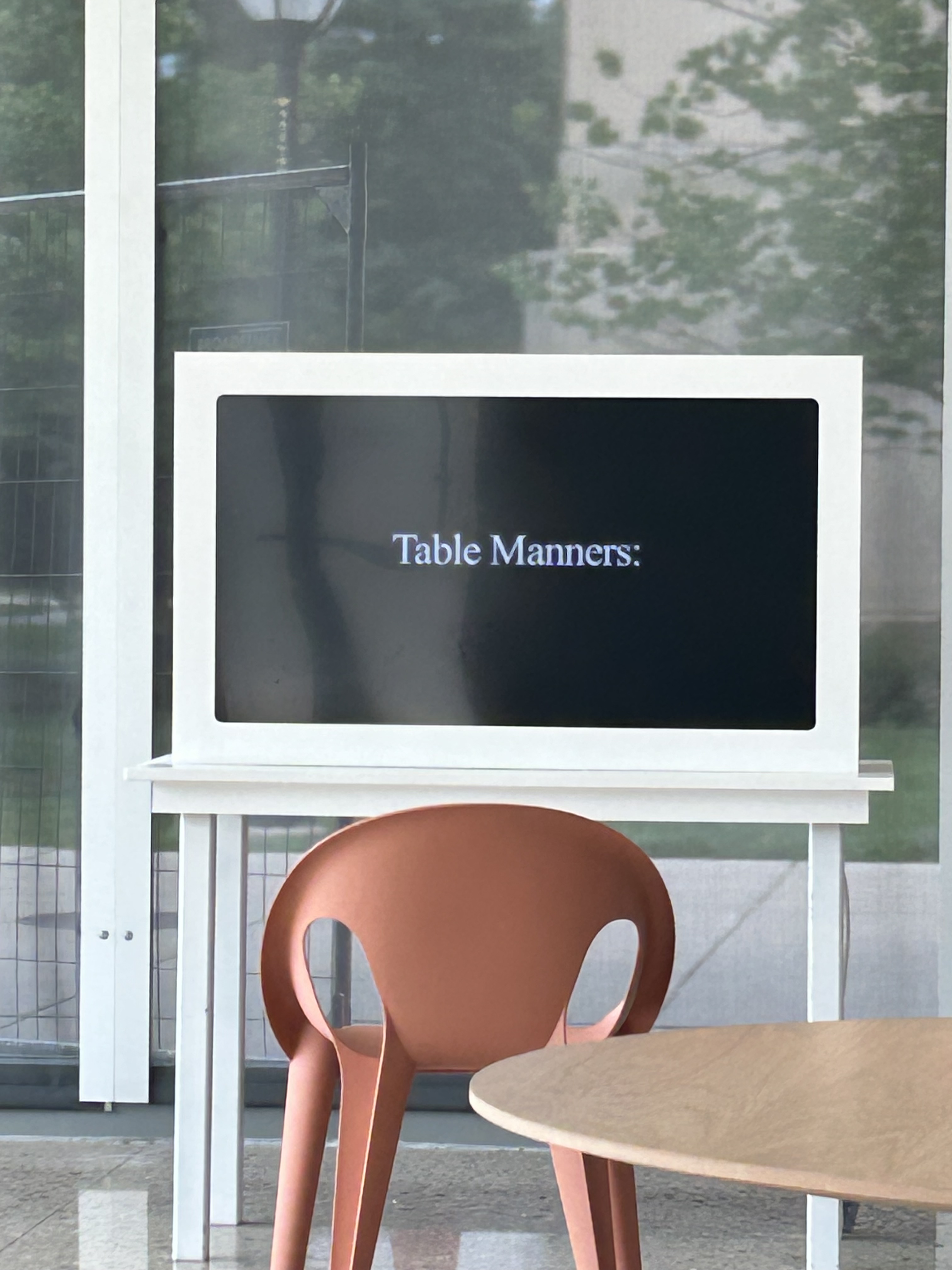
I can’t help thinking about manners in the context of deprivation, famine, and eating for survival. In this sense, manners are about dis-placement: dis-placement when we are forced away from the land that provides us with food and nurtures us and dis-placement through violent destruction of that land from climate heating or crimes against humanity. Mineral extraction, oil drilling, and global capitalism hand out such misery, and did so in the Niger Delta. Curator Ashley Miller points out that “activists––including the artist’s father, Ken Saro-Wiwa (1941–1995)—fought to protect the land and the [local] Ogoni people from multinational oil companies [Shell Oil, among them] and were executed by the Nigerian military dictatorship that ruled until 1999.”
I think also of the starvation that we witness daily in Gaza and the West Bank, inflicted on Palestinians brutally severed from their land by the Israelis and the U.S.A. (Trump and the Republican Party, yes, but also Biden and establishment Democrats even in politically progressive states, such as Oregon Senator Ron Wyden).
Put differently, manners are an act of self-determination. When Saro-Wiwa talks about powerful exchanges, I think this is what she means. We watch someone eat; we understand the manner and force of food to affirm our connectedness to place and to each other, to who we are and who we want to be.
Zina Saro-Wiwa
Table Manners: Season 1
2014–16
8 single-channel digital videos
Duration: between 5–11 minutes each video. Edition of 3 plus 2 artist’s proofs.
University of Michigan Museum of Art, August 9, 2025–August 9, 2026
Curated by Ashley Miller, Assistant Curator of African Art
For an interview with the artist, see Ava Pustulka, “UMMA invites visitors to take a seat at Zina Saro-Wiwa’s ‘Table Manners’ exhibition” in the Michigan Daily (September 23, 2025)
To watch an abbreviated version of one of the videos titled “Grace Eats Garden Eggs with Spicy Ground Nut Butter,” click here.
Tracking organizations like Track AIPAC report that Ron Wyden has received a cumulative total of approximately $414,693 USD over his career from pro-Israel political action committees and aligned interest groups. He is up for re-election in 2028. Oregon Senator Jeff Merkley in stark contrast refuses AIPAC funding.


LisaThank you so much for your article.I will read it later.Best,Ellen Sent from my iPhoneOn Aug 11, 2026,
LikeLike
Hi Ellen, I just discovered your new address this afternoon. Next time I am in Michigan, I will come by to visit you! I hope all is well. I think of you often. Please stay in touch. Warmest wishes–
LikeLike