The postcard of Johannes Vermeer’s Milkmaid is propped up against a window in the dining room of my parent’s home, next to some spider plants and Venetian red glass. The light coming through the window is warm yellow in the winter, and chilly green in the summer. It can make it hard to see the picture.
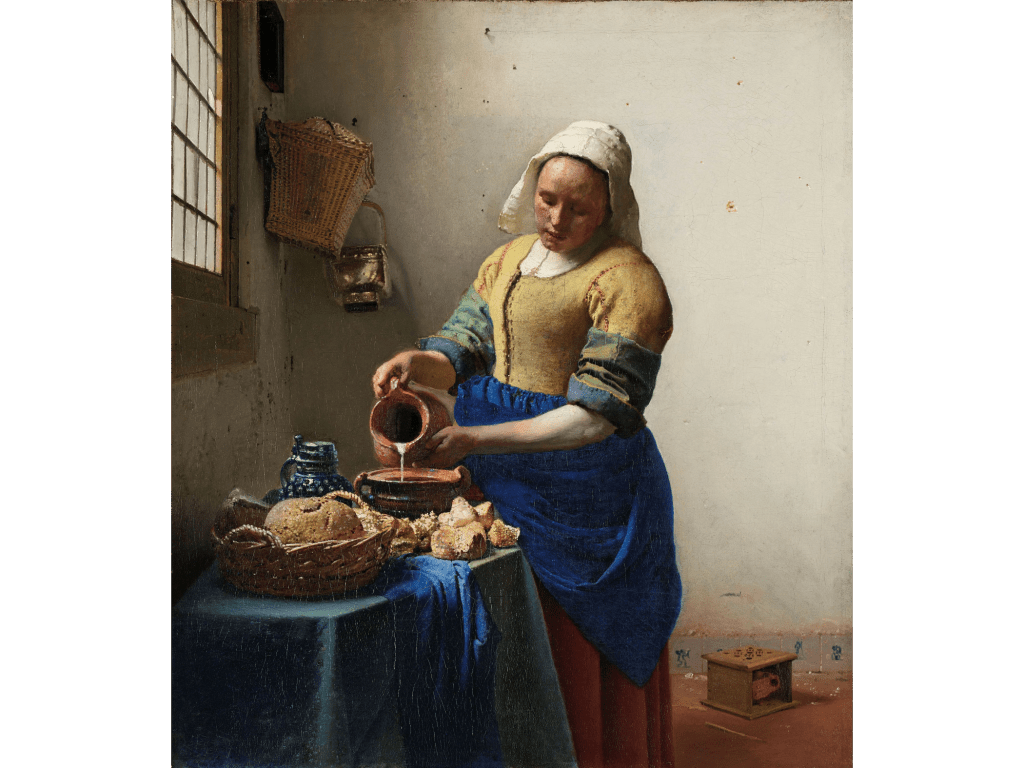
This is a memory. I moved out of my parent’s home (now someone else’s home) forty years or so ago. But recently I have been thinking a lot about that picture, and what it tells me about my mother, who put it there. When asked about it, she says that Vermeer didn’t paint too many pictures, so it interested her. But I have to wonder.
The painting communicates working-class Dutch realities. A woman pours milk from clay pitcher to bowl. Her shoulders and arms are heavy, pale where her sleeves are pushed up to reveal a farmer’s tan––dark brown-red forearms, wrists, and hands. Her cheeks are equally ruddy, as if she has a high flush, though her bare face conveys an impression of blondness somehow (her hair is hidden under a starched mob cap)––possibly it’s the effect of the white window light glancing off her right temple and high forehead. She looks down.
The room isn’t pristine. Iron nails protrude from the plaster walls. Under peeling paint at the floorboards there is a row of dusty delft tiles, and a foot stove. But the tabletop is clean. Rolls of bread (hard, crumb-less) ring the bowl and a woven breadbasket on the cloth.
The (typical Dutch) cataloguing of things that I have just provided (though not truly encyclopaedic) would appeal to my Dutch-heritage mother who grew up on a dairy farm in Wisconsin among Bruins and Loomans and Kamphuises. Beyond that, there is an emotion to the painting. The emotion comes from the sense that it’s not entirely clear that the milkmaid actually sees what she is looking at. Yes, she is preparing bread pudding (melksop), a traditional dish that uses up stale bread by soaking it in warm milk. Nothing is going to waste. But there’s something about that downward gaze that is meditative and quiet.
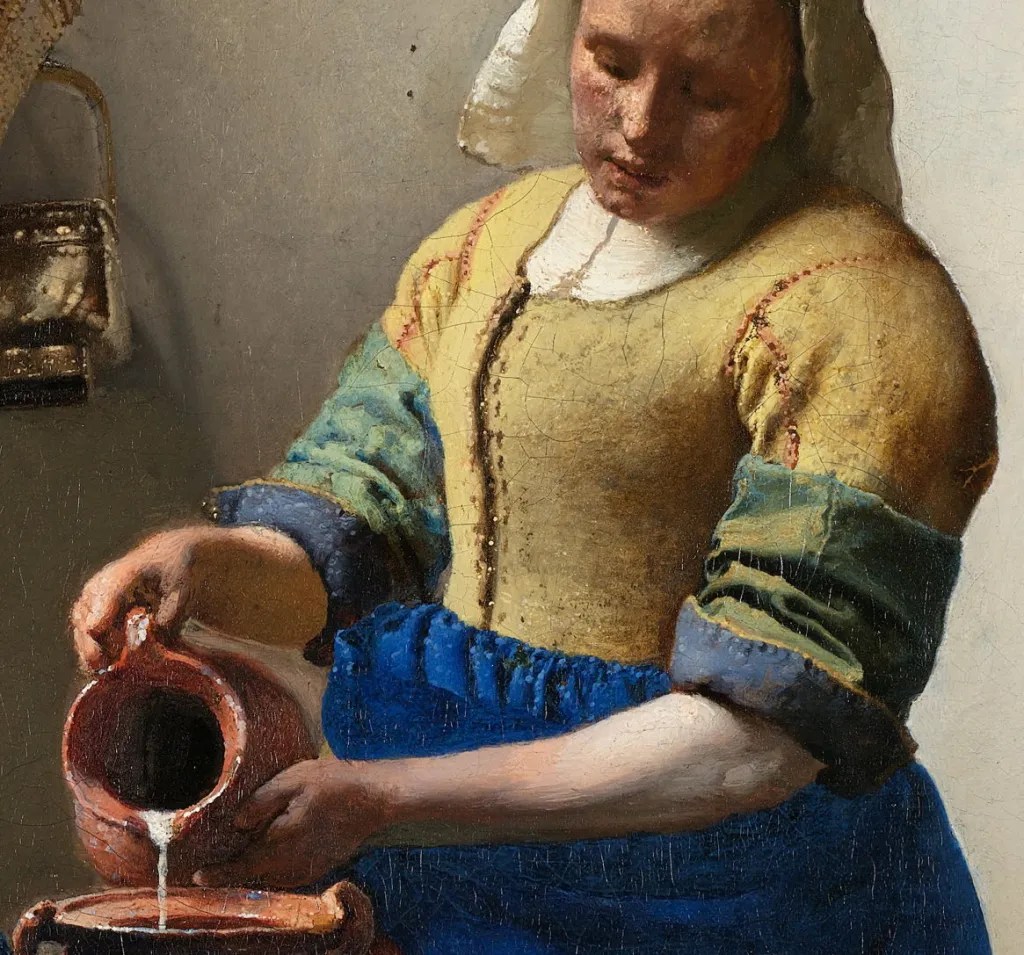
And I think it is this simple, honest thing about the painting that appeals to my mother: the power of the imagination and interiority against the demands of hard labour; the stolen moment of daydreaming amidst a hard day’s work.
Johannes Vermeer, Het melkmeisje (The Milkmaid). ca. 1660. Oil on canvas; 45.5 x 41 cm. Rijksmuseum, Amsterdam
 staring at the ceiling