
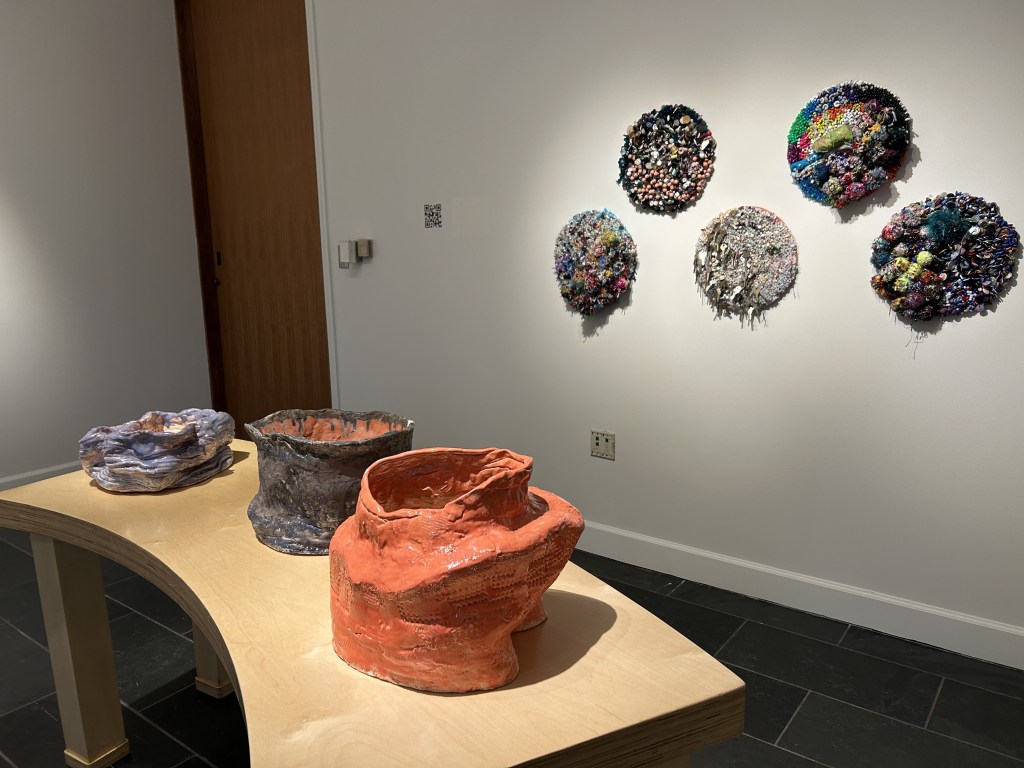
The vessel slumps. It is a reminder of how much clay is like flesh––lumpy, striated, colourful. Although clay rarely is allowed to be just clay, as it is here; its materiality typically is disguised by the uniformity created through the potter’s wheel or straightforward industrial production, or by immaculately glazed surfaces. Even in perfectly imperfect Japanese ceramics, the fingermarks of the maker rarely appear, and the flakes of clay cut from the vessels are not allowed to bake into their bodies (and they are bodies; think of the language we use to we talk about them, from the foot to the belly to the shoulder to the neck to the lip).

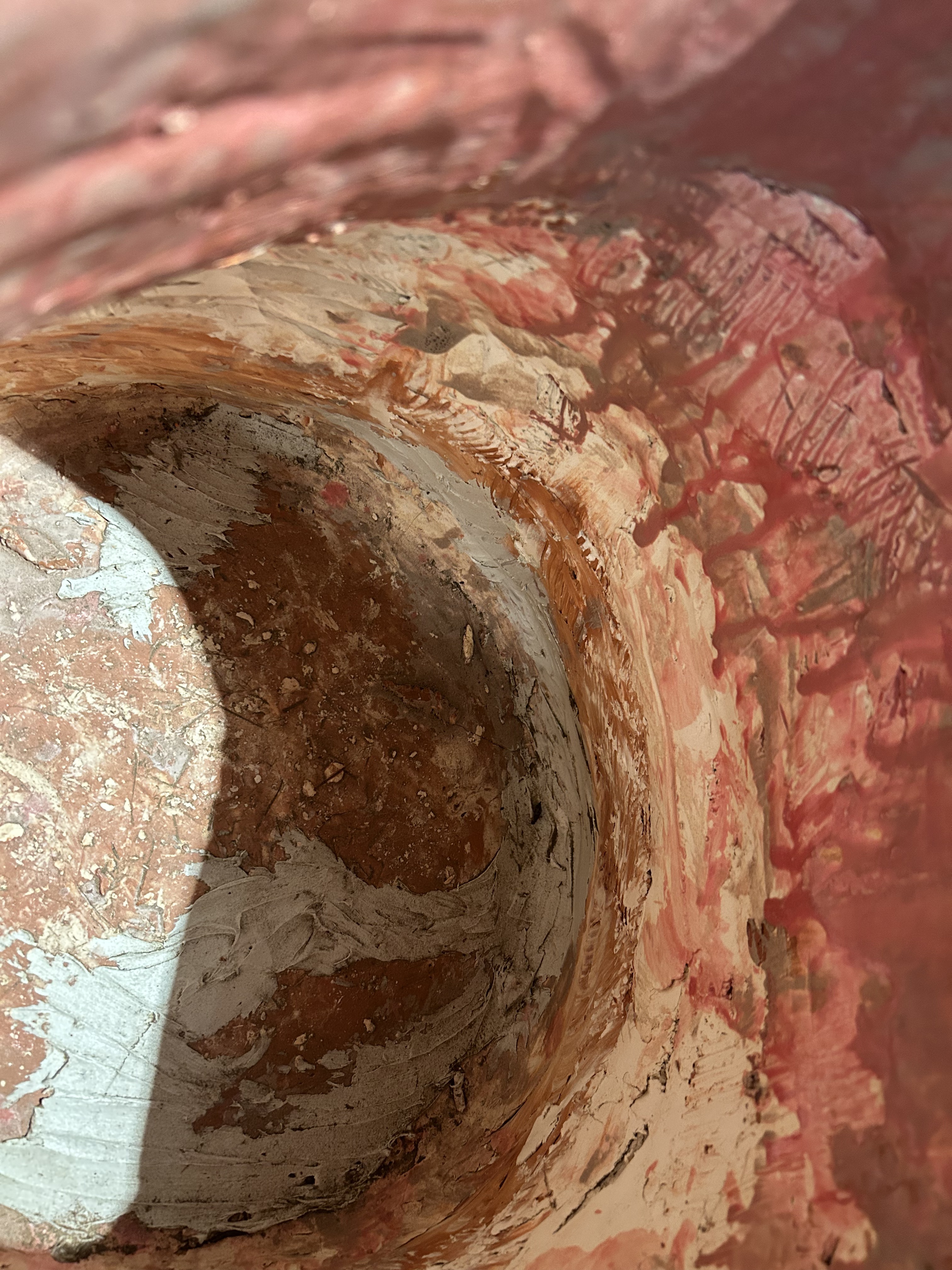


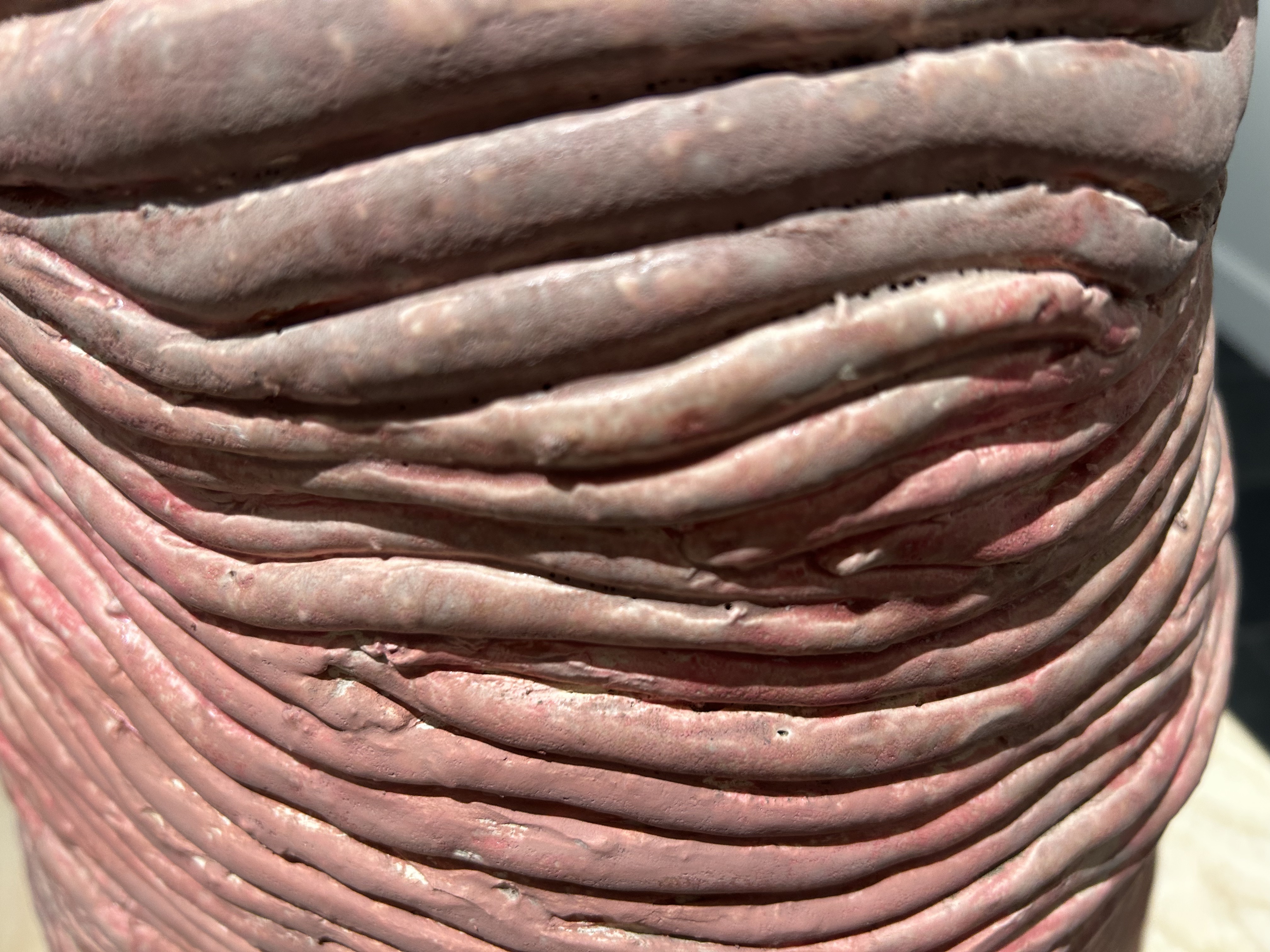
My own fingertips fit into the prints left behind by the artist. The gallery encourages such gentle touch. After all, it is through touch, mainly, that the artist, Ericka Lopez, defines texture and shape, and sees colour. Scent also plays a critical role, as does memory. Lopez is blind.
And you do want to touch her artwork. Take, for instance, that slumping pot. The coils of clay are thick, then thin, and pushed inwards, then out. They’re glazed––a darkish pink colour––but it’s not a glaze that refracts light. The colour is dull. And the pink is not always pink. On the interior, though, the glaze is a solid raspberry red, waxy thick, yet it, too, is not uniform. It drips and pools. The repaired parts of the vessel below are raw and undisguised. The juxtaposition of textures invites touch.
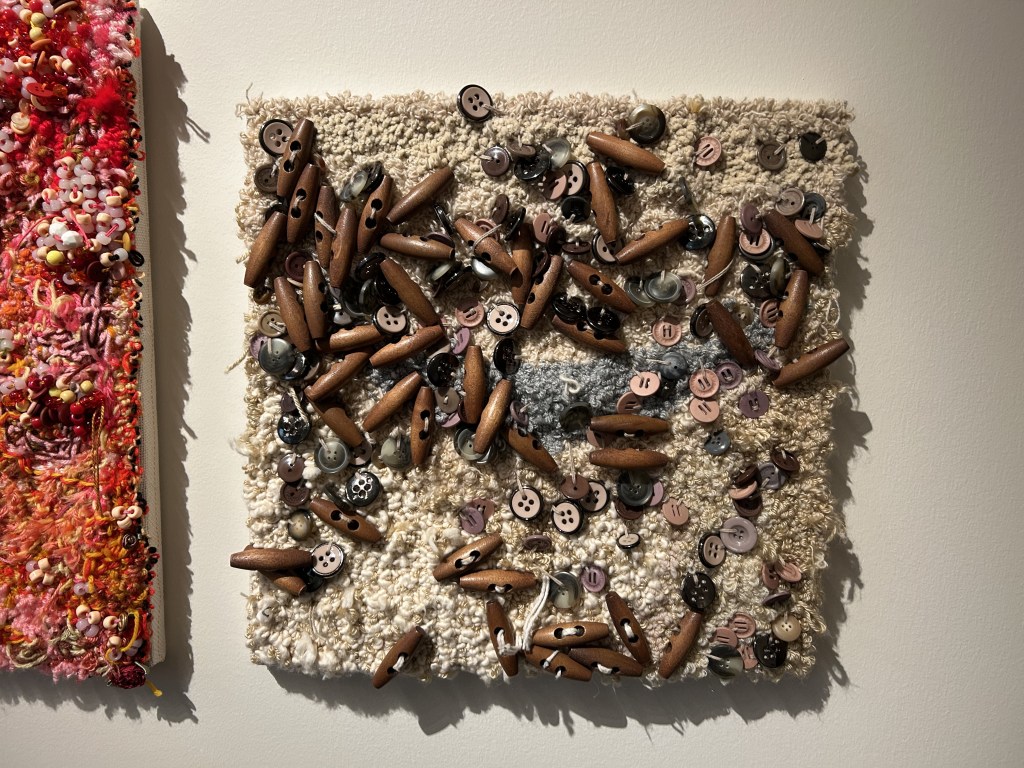
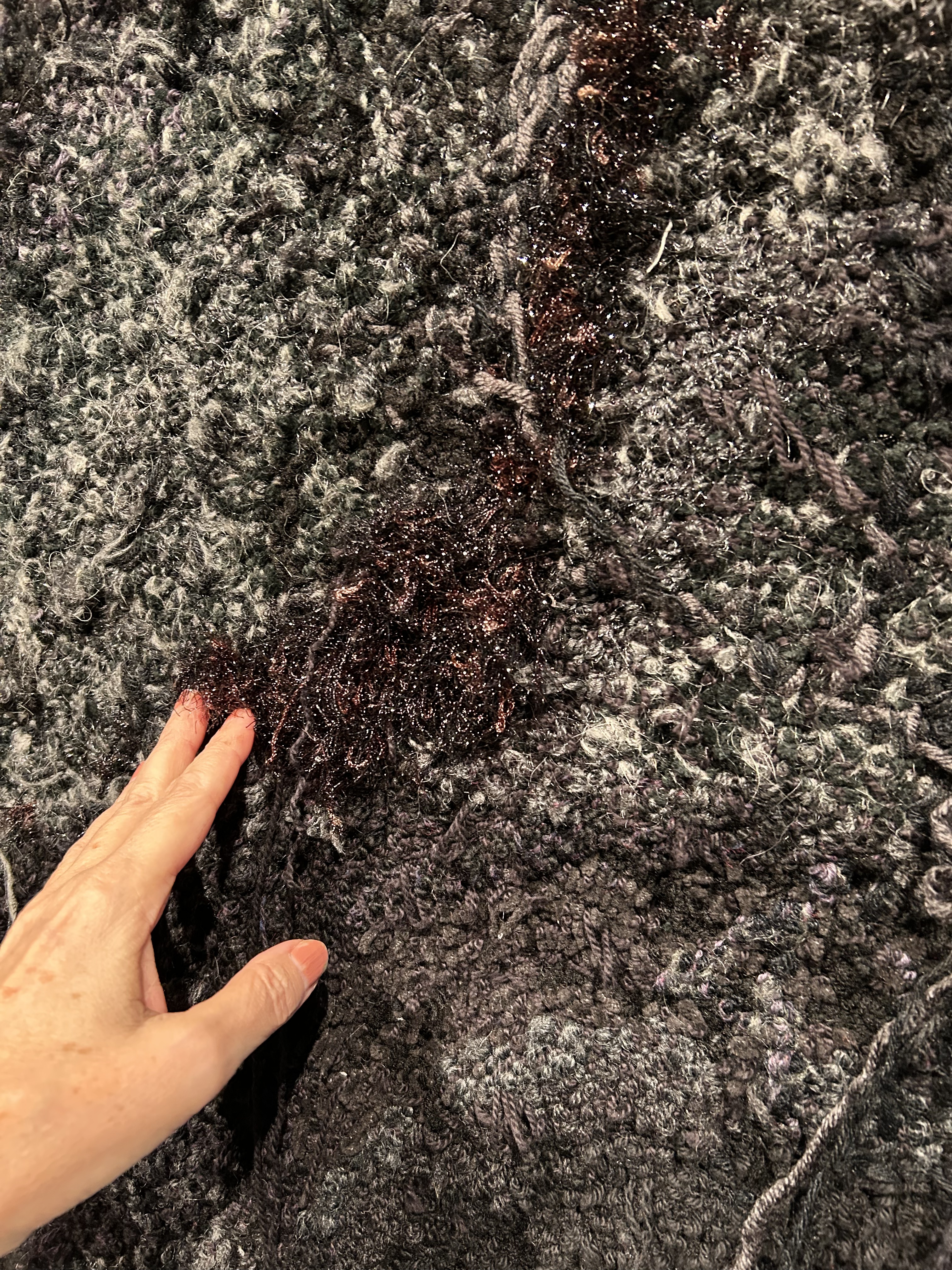
Or take Lopez’s square textile artworks, created by pulling yarn into a stretched fabric surface with a punch needle. One is composed of loops of metallic off-white and gray yarns to which buttons in shades of tan and brown have been attached. It feels maggoty to me, in a slightly unnerving way, but it also wants me to touch it.

Lopez’s colours, too, are tangible. In fact, her artworks are colour studies. For instance, black (singular) becomes blacks (plural) in one punch-rug textile. Glittery purple-black at the centre slips through blacks that are a cooler gray-blue, greener. Such black on black reminds me of the great Dutch designer Hella Jongerius’s colour explorations. Jongerius also weaves together colours. And like Lopez, she is interested in the subjective apprehension of colour. Jongerius writes that,


The all-encompassing RAL, Pantone and NCS colour systems offer millions of colours, categorised, structured and sorted for us…But how can we ever intimately relate to colour and its subjective effect in this scenario? The largest part of the effect of a colour is made up of its quality. The perfectly sorted colour systems with their immaculacy seem to neglect this aspect.
The quality of colour resides in its tangibility. For Jongeruis, light activates colour, or the other way around; for Lopez, it is the hand.
The curator’s conclusion that Lopez’s blind touch opens portals to imagined worlds is and is not quite on point. What we see is very precisely our own world, rather than an imagined one, re-presented back to us through clusters of keys, gold-painted buttons, clear plastic beads, and clay vessels that dip and slouch. It is one that comes alive through its messy materiality and the vibrancy of pink next to purple next to green next to orange. It confirms the power of imagination as a force in our everyday life through the bits and pieces of things overlooked and discarded, and their spectrum of three-dimensional colour. It opens our inner eyes to beauty.
November 6 – December 13, 2024
Institute for the Humanities Gallery, 202 S. Thayer
University of Michigan
Gallery hours: M-F 9am-5pm
On Jongeruis: https://tlmagazine.com/jongerius-breathing-colour/
On Lopez https://lsa.umich.edu/humanities/gallery/current-exhibitions/ericka-lopez.html
 staring at the ceiling