
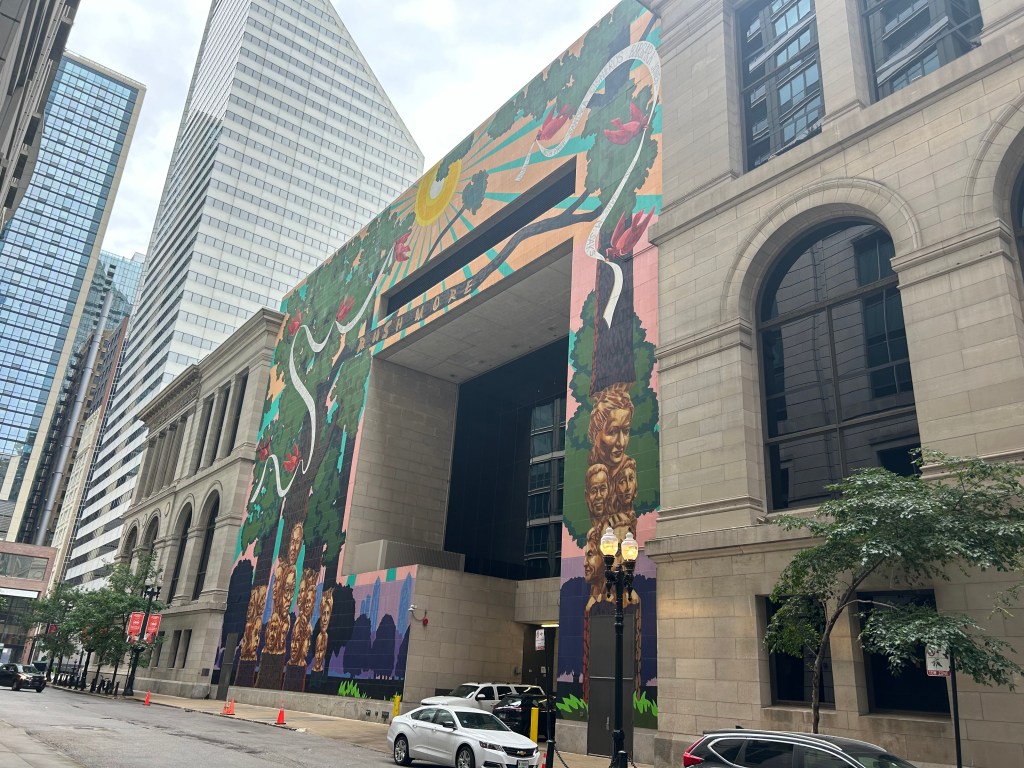
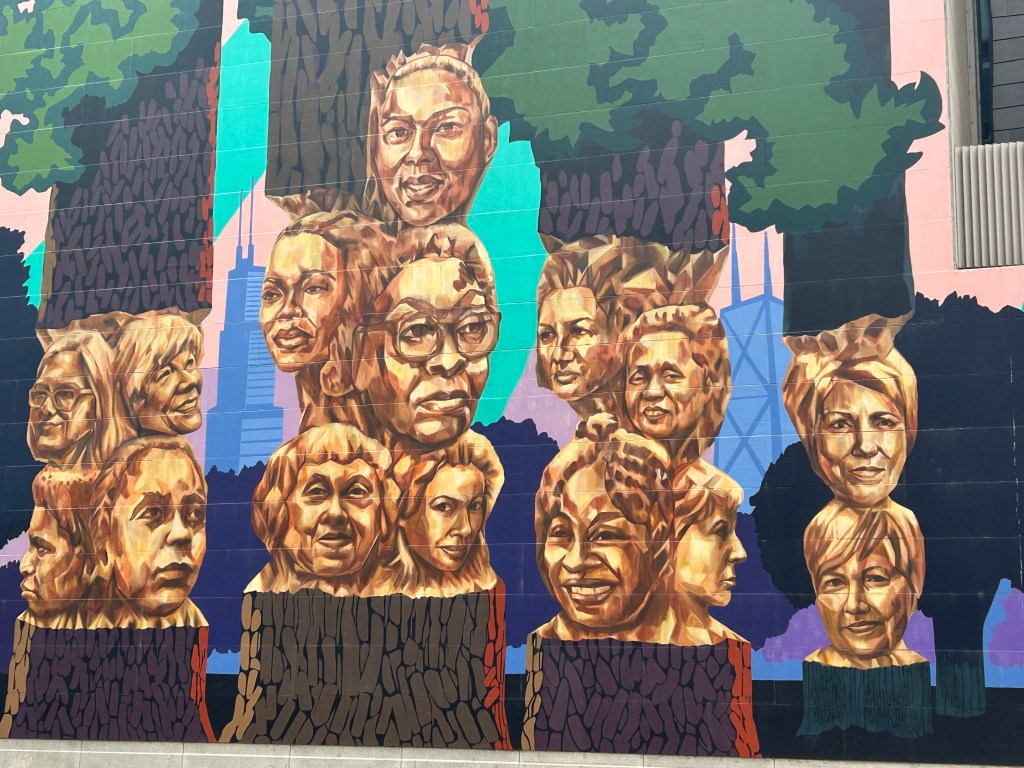
Living rock or living trees. Gutzon Borglum, his son Lincoln, and his assistant Ivan Houser dynamited then carved the faces of Borglum’s four favourite presidents into the face of Mount Rushmore in South Dakota; Kerry James Marshall designed a mural titled “Rush More” featuring the faces of twenty famous Black Chicagoan women as if carved from living trees on the Chicago Cultural Center. The former is a tribute to American gigantism. The latter is a tribute to local Black history.
Both are monuments to American kitsch.
I mean kitsch in the same way Milan Kundera writes about it:
Kitsch causes two tears to flow in quick succession. The first tear says: How nice to see children running on the grass!
The second tear says: How nice to be moved, together with all mankind, by children running on the grass!
Kitsch dwells in simplicity of form and sentiment. It lies in Teddy Roosevelt’s eyeglasses, Lincoln’s beard, Jefferson’s outward-gazing eyes, Washington’s lipless frown, and equally in Gwendolyn Brook’s eyebrows and Oprah Winfrey’s curving smile. The style of carving itself really is what carries that sense of kitsch; even if you don’t recognize the figure, the overly articulated bones and muscles of each face, the shadows below that larger-than-life nose or eye, the clarity of it all, is what makes it kitsch.
But to circle back: What about that aliveness of the medium (in the flesh or rendered in paint)? Is such monument-making an act of possession or a reconciliation with the natural landscape?
To answer, we could frame the monuments within American eco-colonialism on which both are founded (the buying and selling of Indigenous lands in the West; the emergence of Chicago as a city built in part through the lumber trade). Or we might delve into political culture and genealogy. We could talk about scholarly or popular contexts. But I think that the answer lies more immediately in the kitsch quality of the images. These are not images that ask anyone to see anything differently; their power lies in the ways that they appease rather than challenge the eye. In other words, they are low order images that don’t ask you to think (versus high order images that do ask you to). The Disneyfication of the “sculpted” environment signals an uncomplicated acceptance that this is the way it is––this is nature, what we see before us, remade in our own image. So, while we can see the kitschy monuments clearly (kitsch demands that instant spark of recognition), they also, in a dark way, demonstrate our failures when it comes to seeing beyond the human.
 staring at the ceiling