The grass is bolted to the ceiling. Rigid metal cylinders hanging from a steel plate give architectural structure to six tiered platforms of wheat grass. They hang mid-air, growing from loamy soil in a downwards direction towards the floor. Below, on a raised platform, there’s another square patch of grass, wiry and unruly, healthier than the yellowing grass above. More long metal cylinders and short plexiglass walls surround this central structure. The industrial plastic encases milkweed and other seeds. It reflects the light of the passing traffic outside the gallery’s windows.

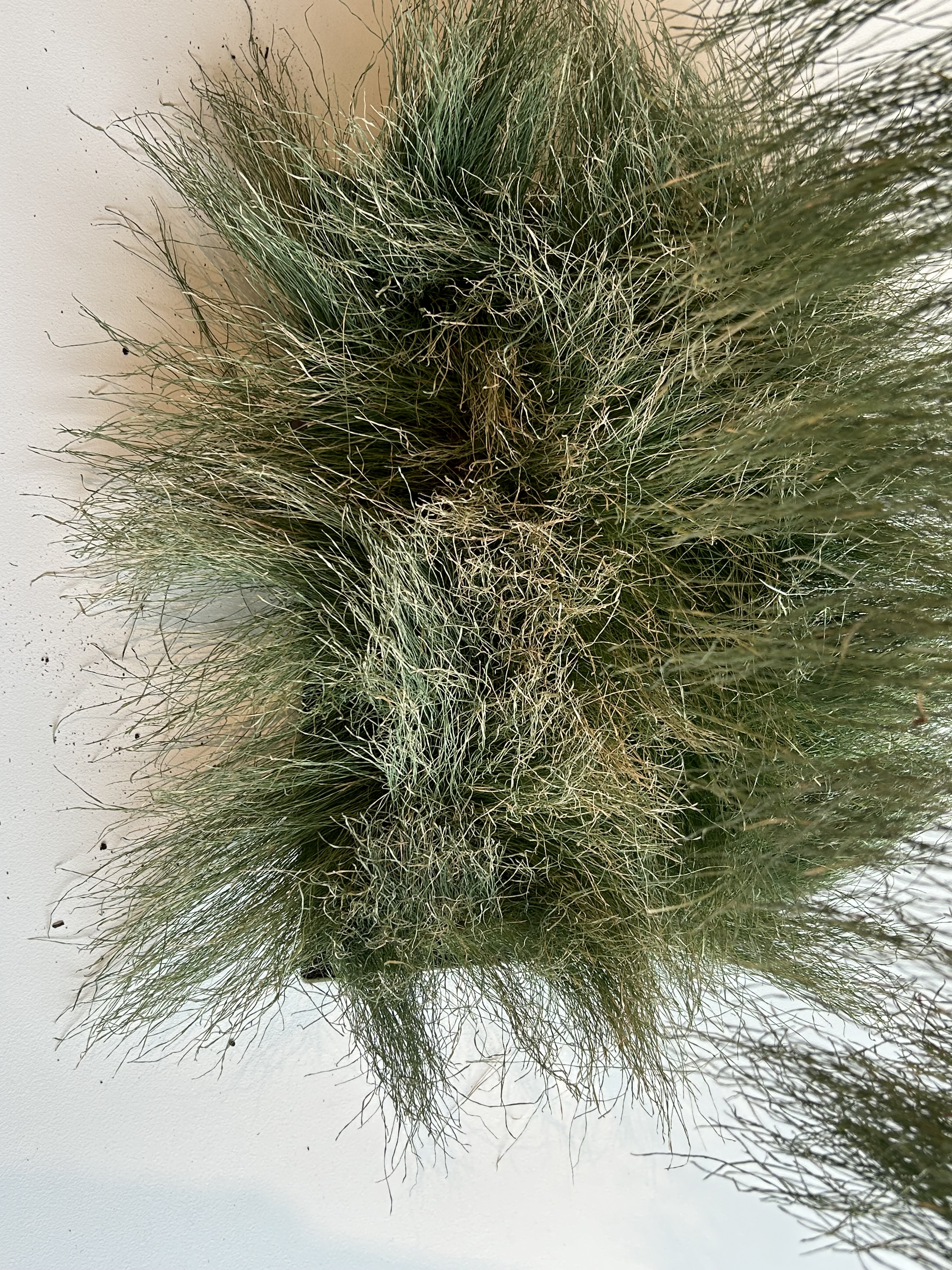
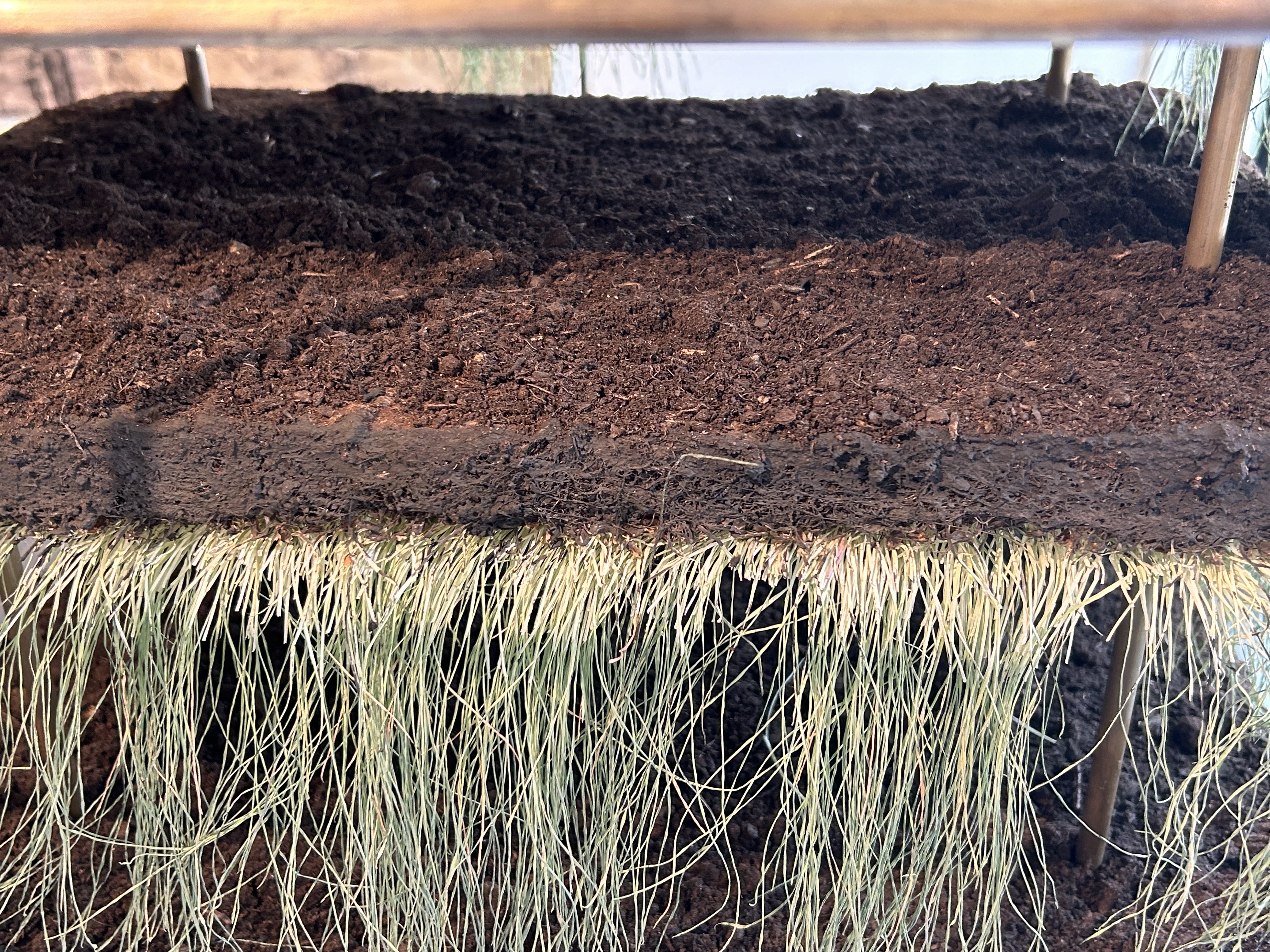


This is an artificial environment, a human-sized built environment, though the organic life in it perturbs its straight lines, its pipes and bolts and synthetic materials. It perturbs, but also, struggles to survive. That will to life is captured in the soil spilling onto the white plastic, or the bean-like nodules at the bottom of the pieces of suspended turf, and even the tips of the grasses, which are greener and more vibrant than the whitened roots.
Nature’s excess creeps through the rest of the exhibition. Nearby are three columns of stacked pieces of sod with root systems configured in the shape of commercial food cartons, muffin trays, rotisserie trays. The sandwiched pieces grow together to create partial columns, unsteady and incomplete, weakly gesturing towards the strength of an architectural element. Behind and on the other walls are paper hangings, their surfaces heavily worked with natural dyes and iron oxide, and stitched together, or multi-layered, one paper cut in sculptural designs to reveal another beneath it. Yellow colour drips from the hangings onto the white walls like bee pollen and collects in the floorboards.


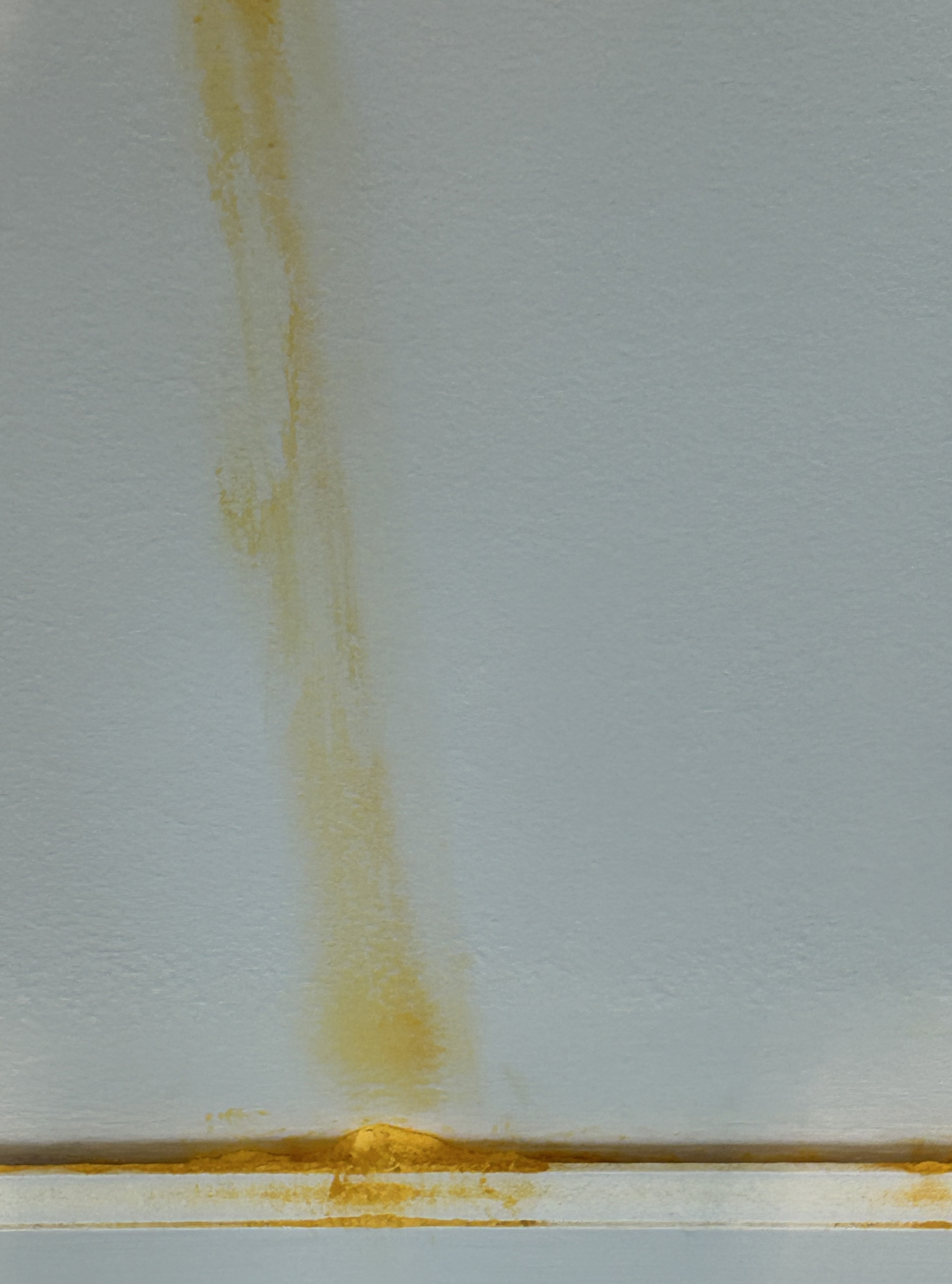


The hangings themselves are uncontained bursts of colour, the pigment seeping into the paper rather than covering it. That the amorphous blobs of eggy yellow and orange are like flowers in one hanging is mostly indicated by stitches of thread that suture them to representational form. The stitches defining circles and petals are different lengths, some loose, some tight; they, too, escape uniformity.
The exhibition embodies the ways that both human and more-than-human occupy the same built environment. In a 2017 interview the artist called it a “mediated ecology,” inspired by her home city of Detroit, where many homes and buildings famously are being reclaimed to nature, and if not to nature, then to farmland. Even more than that, though, the mediation reveals the artist in the act of making to belong to that same ecology in motion. Rather than the repairs suggested by the title of the exhibition (returning to an idealized and perfected whole through a powerful, healing hand), this exhibition (the architectural installations that are only half-stable; the organic dyes that slide from the paper onto the white walls of the gallery) serves as a brilliant reminder of the generative power of decay––decay as part of a life cycle that cannot be controlled even as it is fabricated by the hands of the artist.
On view at:
University of Michigan Institute for the Humanities Gallery
202 Thayer Street, Ann Arbor
March 13–May 3, 2024
For the 2017 interview with the artist, see: Loney Abrams, “Susan Goethel Campbell on Casting Grass Sculptures in the Shell of Detroit’s Impermanent Landscape,” Artspace (December 14, 2017)
 staring at the ceiling