It could be a bank. The building façade is flatly geometric, heavy sandstone configured in two rectangular columns on either end of an elevated porch, bracketing four Doric columns at the centre, unfluted, ungracious, massive. The cornice is punctuated with boxy forms mimicking the bosses at the tops of the columns. The walls to either side are embellished with empty frames, admitting more geometry, squares and rectangles. Though small, the building embodies duration, rationality, and stability. Originally, when it opened in 1910, the building served as the Alumni Memorial Hall at the University of Michigan. It later became the Art Museum (it was the museum I used to visit when I was a child growing up in Ann Arbor), and it remains part of the dramatically expanded art museum today.

The façade is not so different from the façade of the National Gallery of Art West Building in Washington, DC, or the façade of the Philadelphia Museum of Art, the British Museum, or the many other museums based on ancient Greek temple design. The architect’s gesture towards the temple anticipates that ritual hush, that solemn behaviour among visitors, that circumspect circumambulation through the halls and before the displays of art, that Carol Duncan has written about in her now classic study Civilizing Rituals (1995). It participates in a museum system that embodies different forms of white settler-capitalist power, for one encouraging conforming behaviours and understandings of how to be in front of a work of art (which often can be a looted object, removed forcibly or with the soft power of money from its original culture, never to be returned, for, as the British Museum put it in a sign in front of the “Elgin” marbles, “art transcends culture”).
But today, the façade is slightly different. It has become white. It’s not a pure marble colour. It is instead a leaky, washy white, a white in which the warmer material of the sandstone is visible. Its transparency contrasts with three densely white, rectangular pieces of canvas hung between the columns. One provides the name of the artist and title of the work (Cannupa Hanska Luger, Mandan, Hidatsa, Arikara, Lakota, Standing Rock Reservation, born 1979, GIFT, 2023, Kaolin, Water). Otherwise, they are blank and opaque, as if an antidote to the authority of the typical museum label, and a way to highlight the changeability of the façade’s colour.
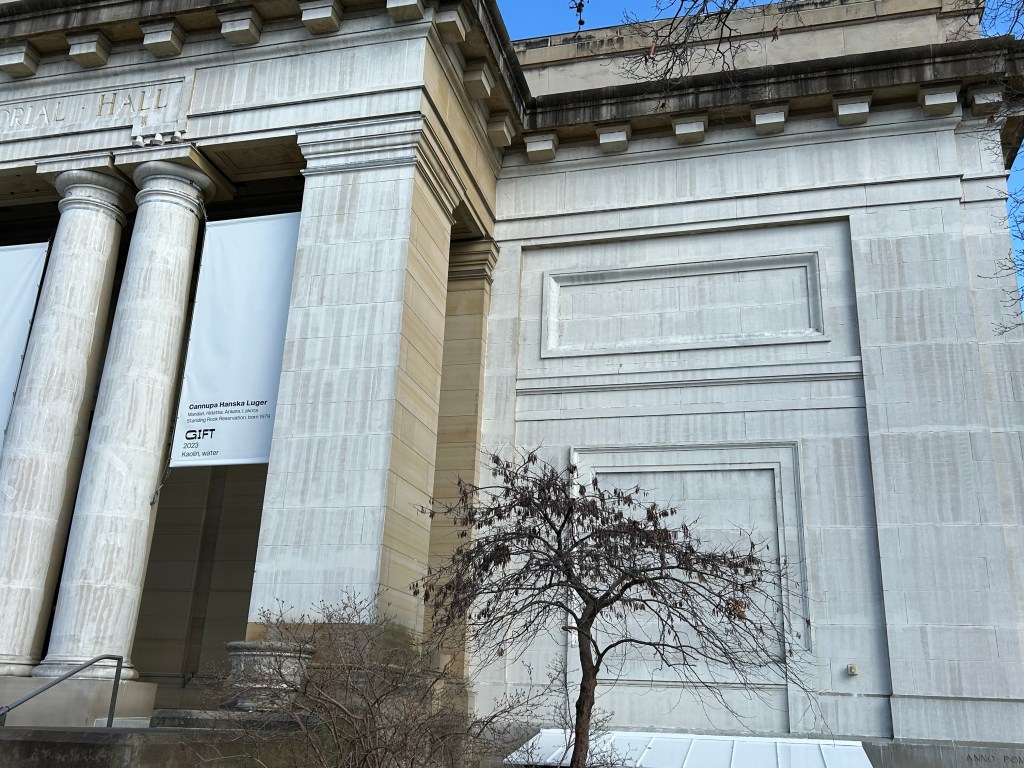
In September 2023, the façade was painted with a thin layer of kaolin clay by Luger and a group of artist collaborators. Today, seven months later, the clay sticks to the stone in ribbons, though on the columns four thick script forms can be made out, one on each column, spelling G-I-F-T. The artist’s point of departure was the 1817 Treaty of Fort Meigs, in which Ottawa, Chippewa, and Potawatomi tribes “gifted” land to the university that was then sold to found its endowments (think of those looted art objects).
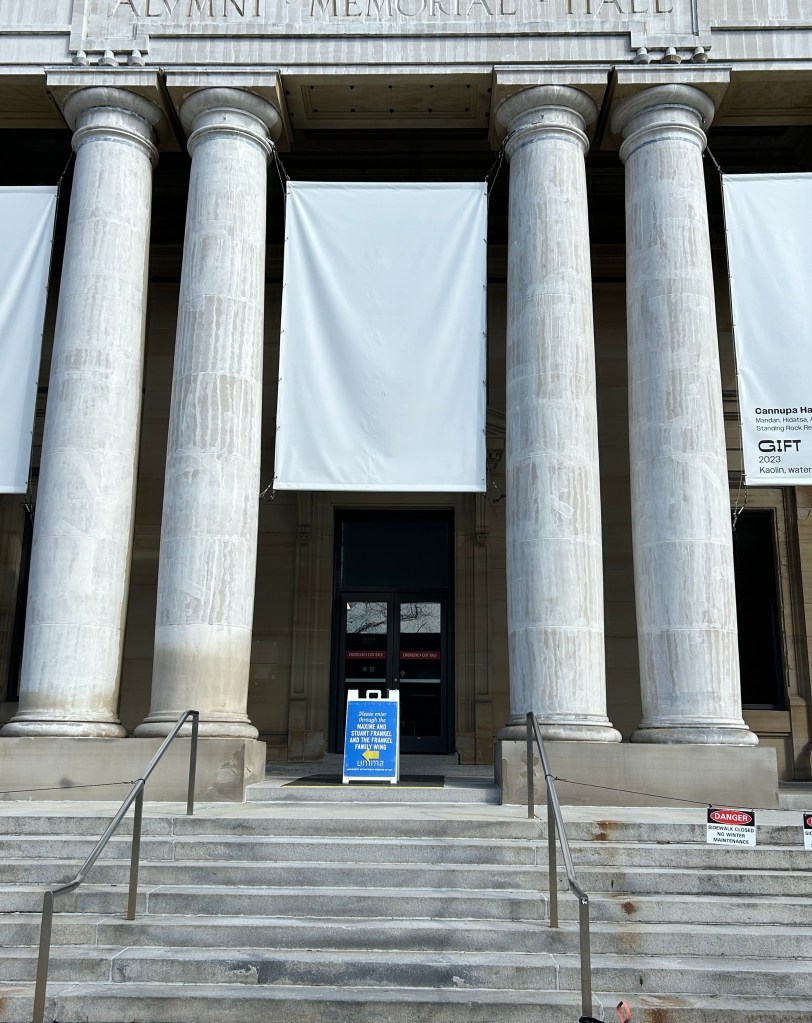
This is time-based art; the clay will eventually disappear––eventually, because it hasn’t really snowed in Michigan this past winter. There have been a few big storms, lasting about 24 hours. One week it rained. So, the white face of the façade is only slowly disappearing, the process made even more gradual by climate change. As the white colour morphs and the clay returns to the earth, and the white washing begins to fade, the building poses big questions of us: What does it mean to see with white vision? How do we see the colour white as the colour white changes? What work does the installation do to encourage us to think about museums as spaces not of power but of community?
 staring at the ceiling