
A personal note: I don’t often blog to promote my professionally published writing. The obscenity of the genocide in Gaza demands that I do now. Below is the introductory paragraph of a visual essay that I recently published in the journal Visual Studies. For the full essay, please visit the journal’s website. If you cannot access the article through your public or university library, send me an email.

One canvas is the deep colour of the sea in the sky; the other, the pale colour of dusty heat. These are not figural pictures, and neither are they entirely abstract. They fit uneasily in the oil painter Liu Xiao-dong’s 刘小东 series of diptychs of people and places in Palestine and Israel, painted more than ten years ago. They mark a caesura between pictures of soldiers and children, the wall of the West Bank checkpoint and the Wailing Wall, a table loaded with food around which an Israeli party celebrates and a circle of idle Palestinian men with legs stretched out, radiating boredom. They point towards geography and space (the Mediterranean, the El-Bariyah Desert). The suggestion of the cadence of the waves breaking on a shore versus the stillness of a desert further points towards time: the beat of time measured versus immeasurable infinity.
This short visual essay on Liu’s 2013 project In Between Israel and Palestine thinks about Palestine time.


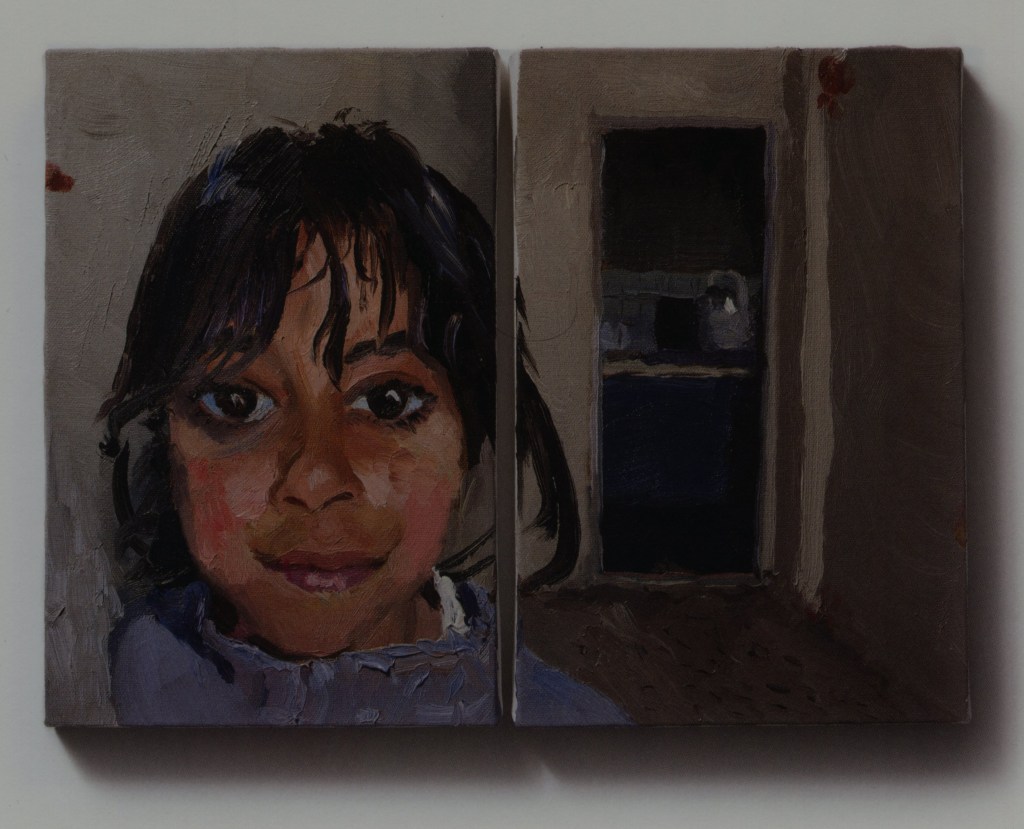

All images by Liu Xiaodong published in his 2013 journal In Between Israel and Palestine (Liu Xiaodong zai Yiselie Balesitan zhijian 2013 nian 4 yue 刘小东在以色列巴勒斯坦之间2013年4月). New York: Mary Boone.
 staring at the ceiling