Introduction from the “Weaving and Pedaling” post, part 1:
One artwork is penciled on the gallery walls in thin lines, barely perceptible; the other is composed of thick blocks of felt in a mural that extends onto the gallery floor, where it vanishes beneath the feet of visitors. One is silvery, thread-like, near colourless; the other, industrial reds against sky blues, egg-yolk yellows against rusty browns, pale tans against dirty grays. Both artworks are measured, modular, geometric.
There’s a precision to the artworks that extends beyond the visible into the mathematically infinite. Which is to say, the artists, Liao Fei and Chen Ke, are thinking hard about how to see and feel that exact moment when flattened form in two dimensions disappears into three dimensions (maybe four). So even though their projects are opposite aesthetically, they share conceptual space; they reveal that boundary between material form and what lies just within and beyond the power of the eyes to see. They do so to affirm a connective free-floating space out there that relies on geometry and tugs at our inner eyes and imagination. (Please see the previous post for a review of Chen Ke’s show).
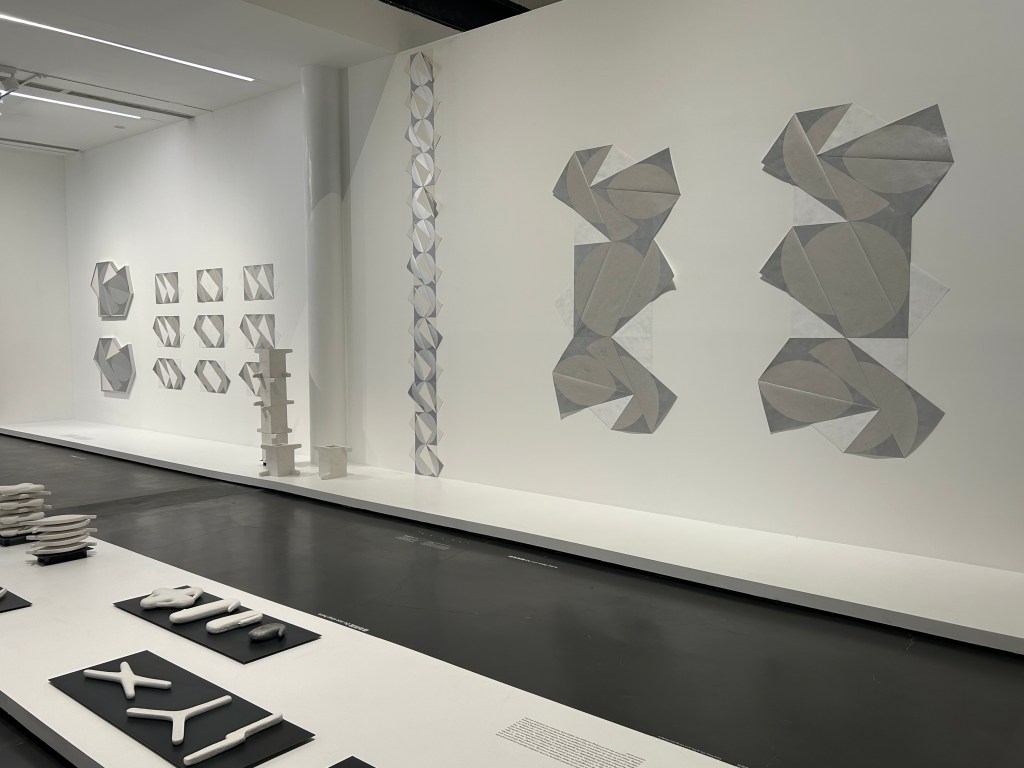

Seeing All Forms, the title of Liao Fei’s show, literally translates from the Chinese as “if humans had eyes.” The word for eye 目 used here also is used in words that translate as looking 过目 (literally, passing the eyes over) and table of contents 目录. Each layer of meaning to the character (the human eye, vision, seriality) is enacted in the exhibition. In the artist’s practice, the interaction between the three can pivot into geometry, but also into particle physics or Buddhist cosmology. It can launch us into space.
What makes the project even more complex is that the multi-layered meaning of the character for eye/looking/series also points towards Liao’s fascination with language itself. He is interested in how language is concrete, thing-like (we can touch it when we pick up a pencil or calligraphy brush, for instance) and disembodied (language is an abstract structure in which we collectively dwell). It is personal and subjective; it occupies spaces that allow us to imagine who we are.
There is, in sum, a peculiar spatial triangulation in Liao’s projects between material representation, visibility, and poetic legibility that shapes the artist’s space and our own. Take, for instance, a performance titled Signal. In this project, Liao got on a bike and pedalled through city streets. He followed traffic lights. He biked through green lights and turned right at red lights without stopping. He biked one hour every day for thirty days, recording each new route (each new dérive) with a GoPro camera and tracking software. The video makes strange the space of the road, its zebra crossings and bluish-white streetlights, the bumpiness of the ride. Which is to say, the project asks us to think about how human-made rules and chance govern our bodily being. Think of Liao sweating on his bike, not really knowing where he would go next, or where he would end up, just pedalling along and letting the stoplights and asphalt dictate his direction.

But the project loses its bodily presence through a series of thirty GPS images documenting each unique route. The routes look like script glowing against city maps––the kinds of maps that we look at every day on our smart phones. Because the GPS images show us the starting and ending points of the journeys and how to get from one corner to the next, they resonate with Chinese characters which are written in a particular stroke order. And like calligraphy, the drawing of each line is deeply subjective––Liao is making up the characters with his body and bike, after all. But his routes also create patterns that look like they could be read. To qualify: although illegible in some ways, those routes can be read; for those of us who know the city of Shanghai, we can redraft each character/route in our mind’s eye, visualizing Zhonghua Middle School or the West Train Station as points of spatial reference.
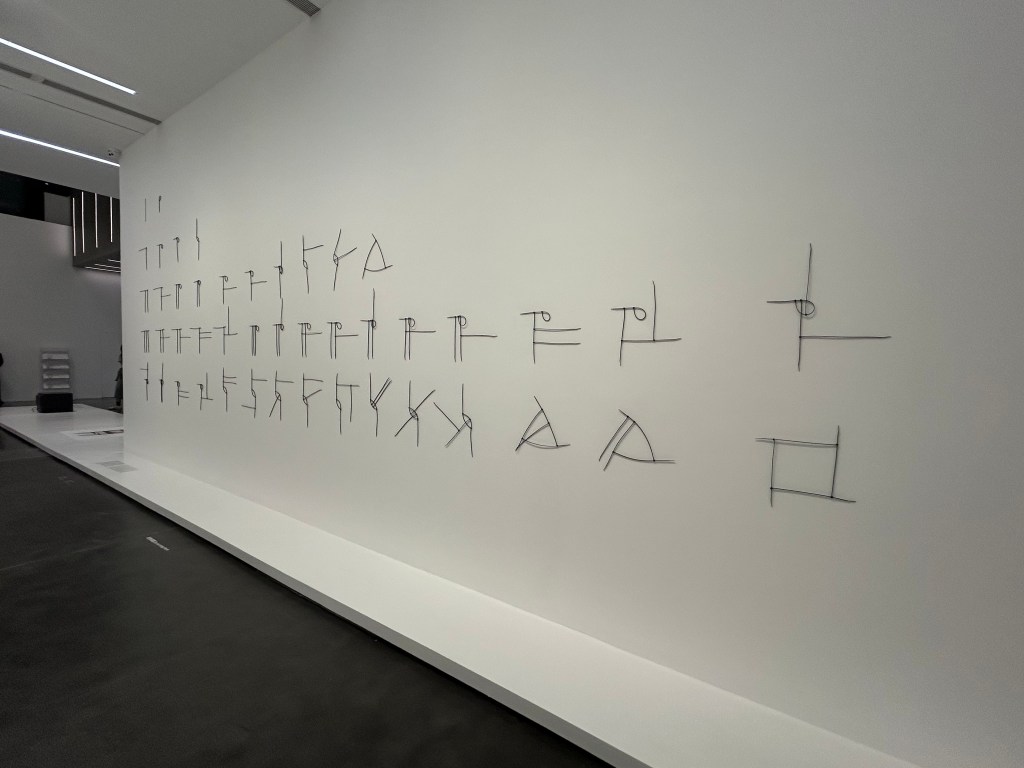
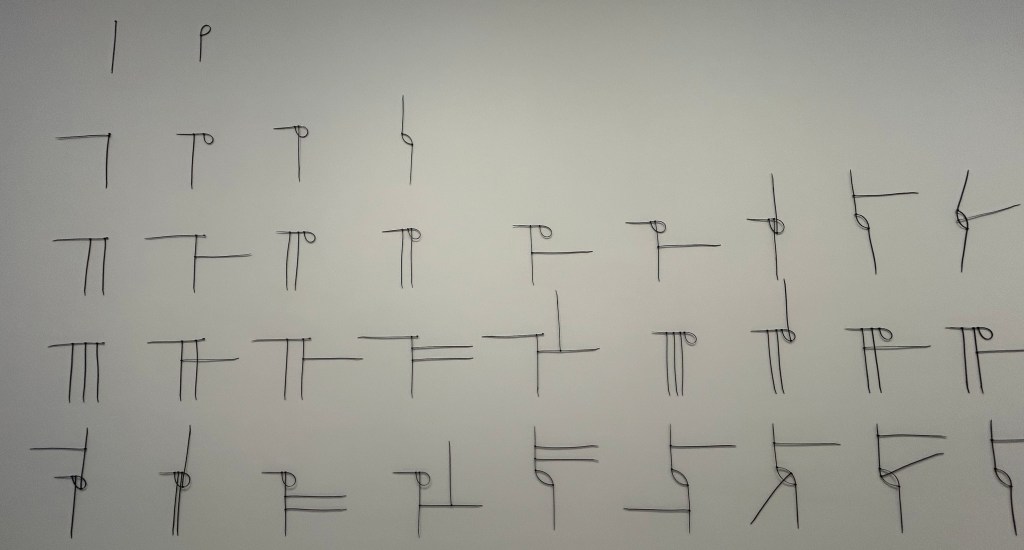
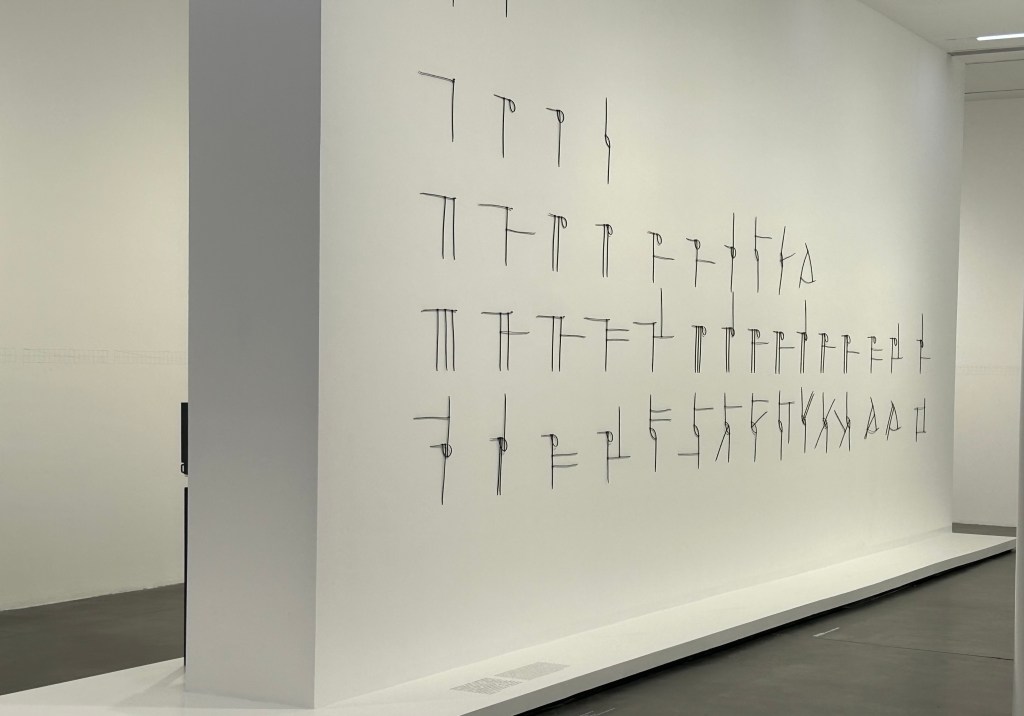
One-Way Sculpture, 1–4 is a series of hieroglyphic black forms mounted on a white wall. They’re plastic cable ties. These are special things in the world because their design demands a spatial logic: they can only extend outwards from a single connection point, and the head of the cable can only be secured to the notches at the top of the cable if it is twisted in one direction. The curator Neil Zhang 张南昭 explains that “due to these limitations, the artist conceives of the cable tie as a ‘quarter line’ –– only extending in one of two directions, and then only able to bend in one of two ways. Thus, even though the potential shapes that can be formed by a cable tie may seem infinite, they can be exhausted with relative ease.” Liao plumbs that point of exhaustion, starting with one straight cable and slowly integrating two, then three, cable tie by cable tie, register by register, to create shapes like ancient Chinese oracle bone script from the second millenium BCE (a tangible gesture towards infinite time) and also like mathematical formulas and pi π symbols (a tangible gesture towards infinite space).
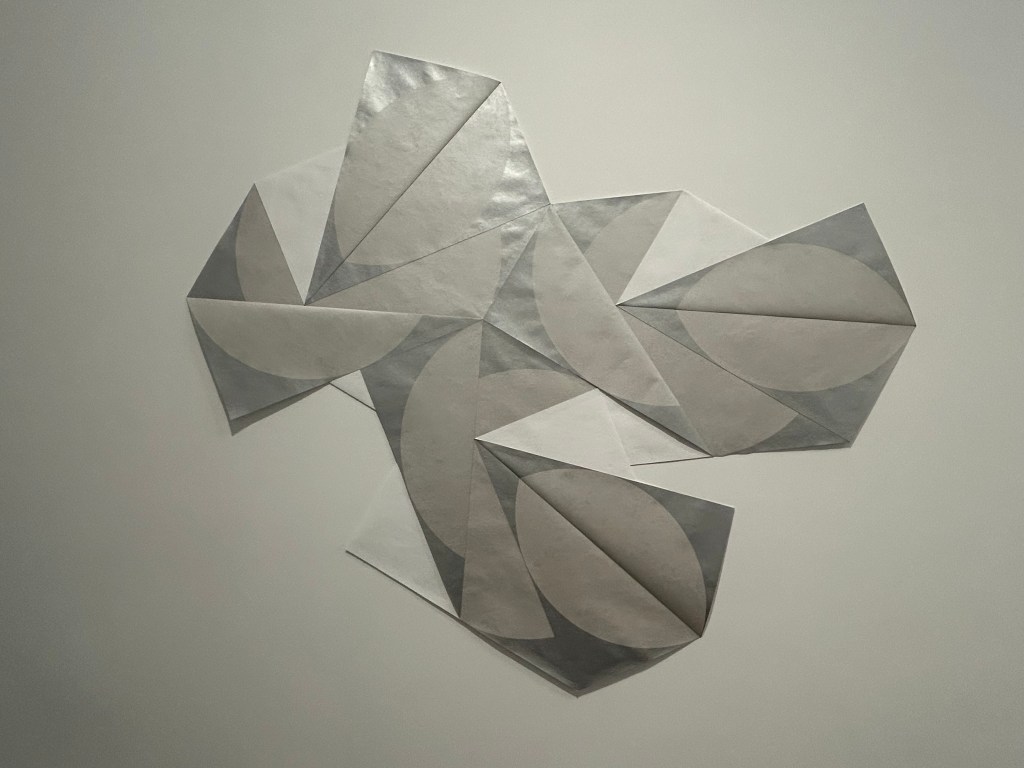
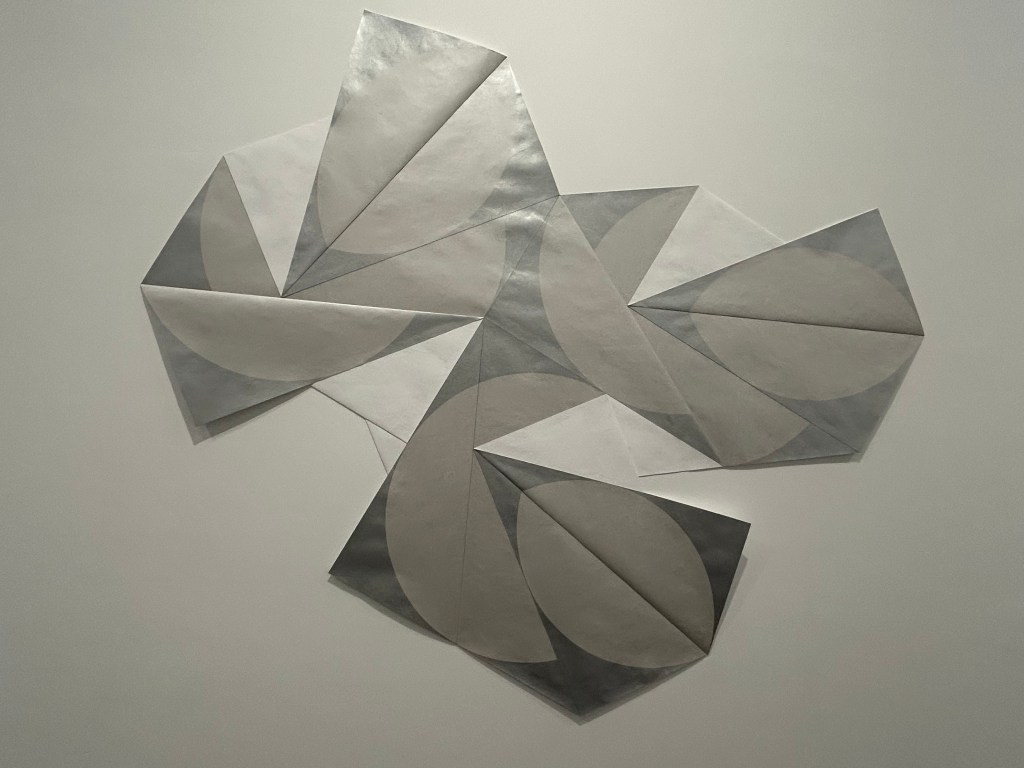
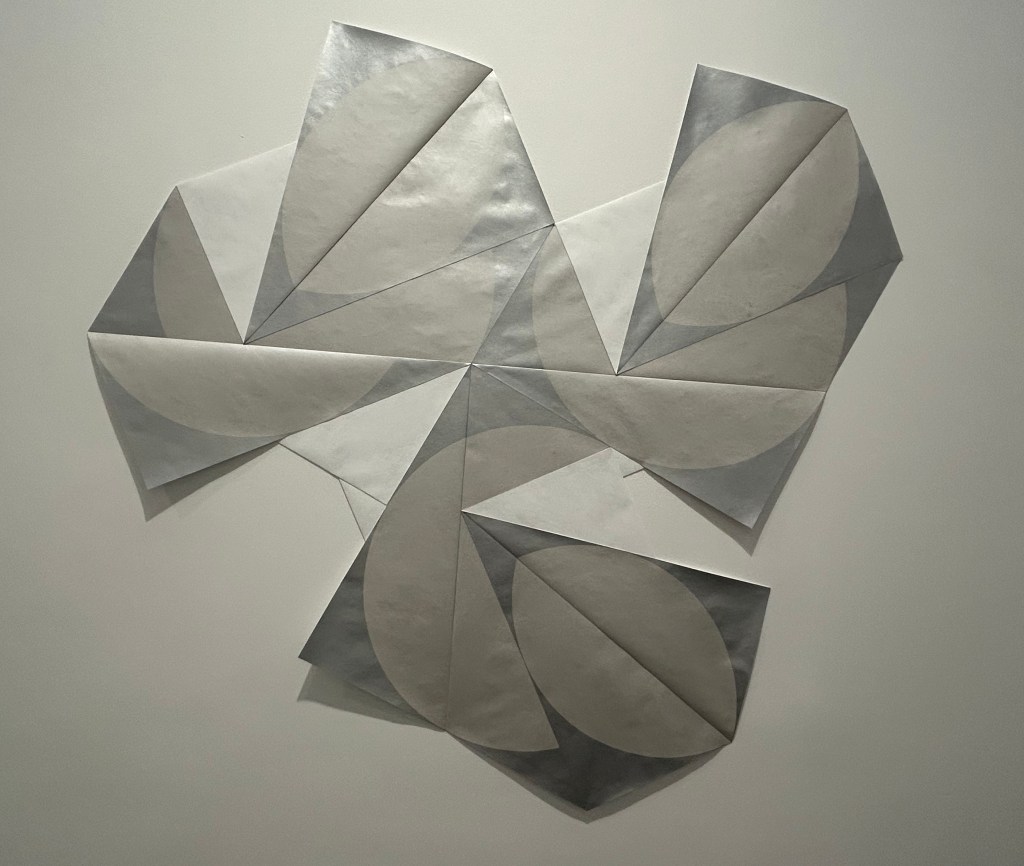
The Partially Obscured Circle series is the most lyrical work in the show, and the most recent. It marks a return to the geometry of Infinite, Natural Typography 1 with which we began this exploration––the penciled graphite rectangular and diagonal lines on the wall, barely visible in the gallery photograph behind One-Way Sculpture, 1–4 . Here, the geometric forms are squares and circles. They are constructed of folded paper. We can’t see all of them (again, the artist plays with visibility and our inner eye), though their perfection is mathematically determined by precise paper folds. They build away from the wall like sculpture (and the deepening silvery-gray colours expand our sense of their papery tangibility), then pull back into flat two-dimensional space. Like all of Liao’s artworks, they are strangely there and ask us to run our eyes over them; they also are not there, occupying spaces beyond visibility that nonetheless are real, just like the spaces of our imagination.

Liao Fei: Seeing All Forms
廖斐:如人有目
- Infinite, Natural Typography 1 《无限自然拓扑》 2017/2025. Charcoal on wall. Dimensions variable.
- Signal 《信号》 2015. Single-channel video, sound, colour; 30 C-prints.
- One-way Sculpture, 1–4 《单向雕塑》. 2017–2020. Plastic cable ties.
- Partially Obscured Circle series 《局部被遮蔽的圆》2024. Matte silver cardstock, paint pen colouring.
Chen Ke: Bauhaus Unknown
陈可:无名包豪斯
Unknown. 2025. Felt.
UCCA Center for Contemporary Art
尤伦斯当代艺术中心
Beijing 798
Both exhibitions on view 2025.5.17–2025.9.7
 staring at the ceiling