Last Friday, in the midst of a fierce snowstorm, I took a bus from Edmonton to Calgary and back (about eight hours on the bus, although I am not complaining; the roads were bad, and the bus felt like a heavy boat safely travelling down the QE2 highway). I had to go because the Chinese Visa Services Centre in Calgary requires applicants to show up in person. Happily, I was able to squeeze in visits to the Esker Foundation and Contemporary Calgary. Rajni Perera & Marigold Santos: Efflorescence/The Way We Wake at the latter is a brilliant show about collaboration, cultural imagination and storytelling, and about creating a sense of what it means to dwell in a diaspora. It demands that you immerse yourself in the gallery, meaning that it demands time––and time was very precisely what I did not have. So, instead of attempting to write a review about the complex dialogue between the artists or reflect on the equally complex mood of the gallery, I have chosen to write about only a few of the paintings by Rajni Perera, with apologies to her, to Marigold Santos, and to the curator Cheryl Sim.
A doubled line smoothly loops and trails specks of red oxide against washy brown pink. It creates the contour of a female body. Knees knock out slightly, feet curve inwards, heels press against butt, nipple touches thigh. Ears match nipple. The arms loosely circling the knees are patterned in henna-red; the eyes, lips, and vulva lacquered in black and ultramarine blue.
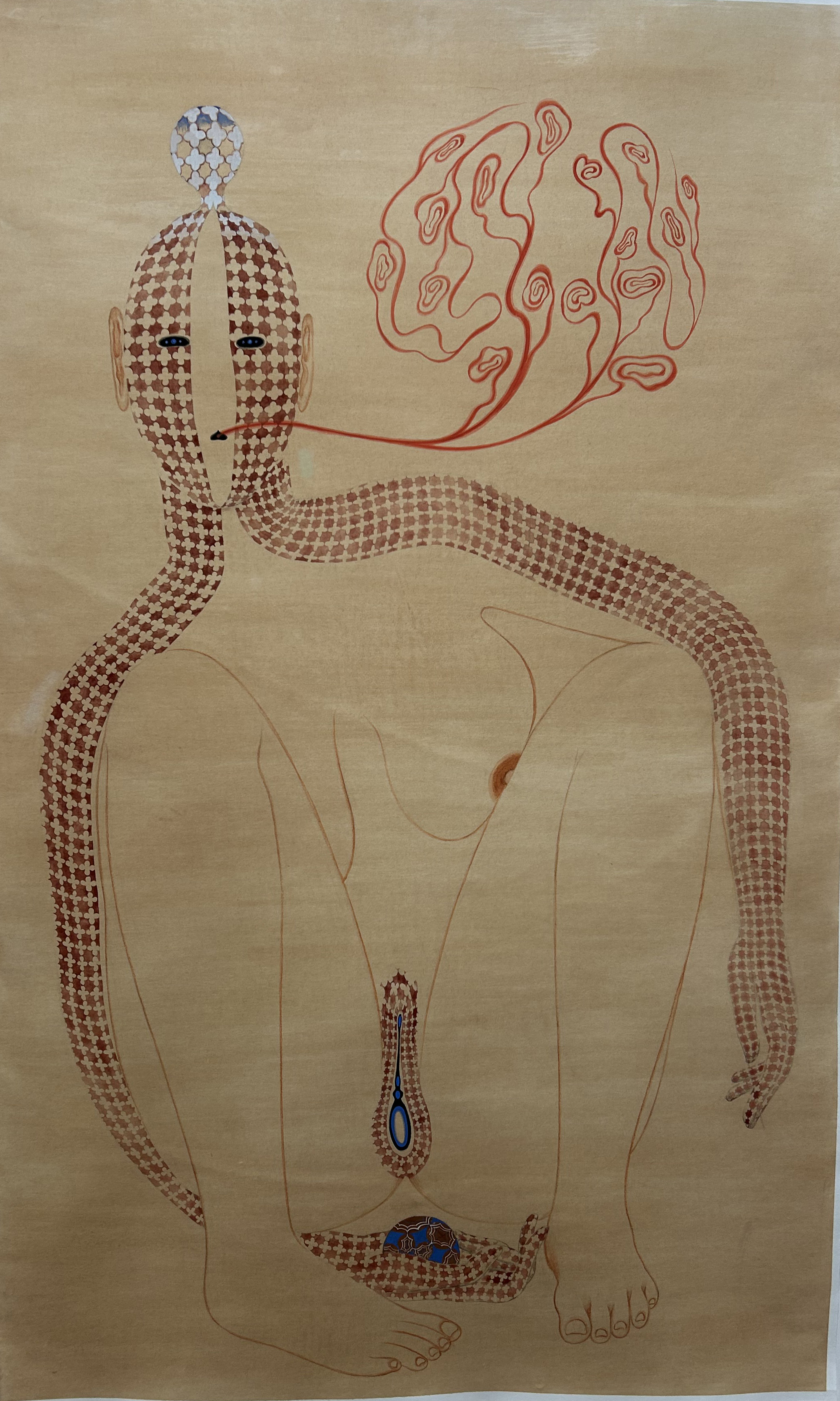


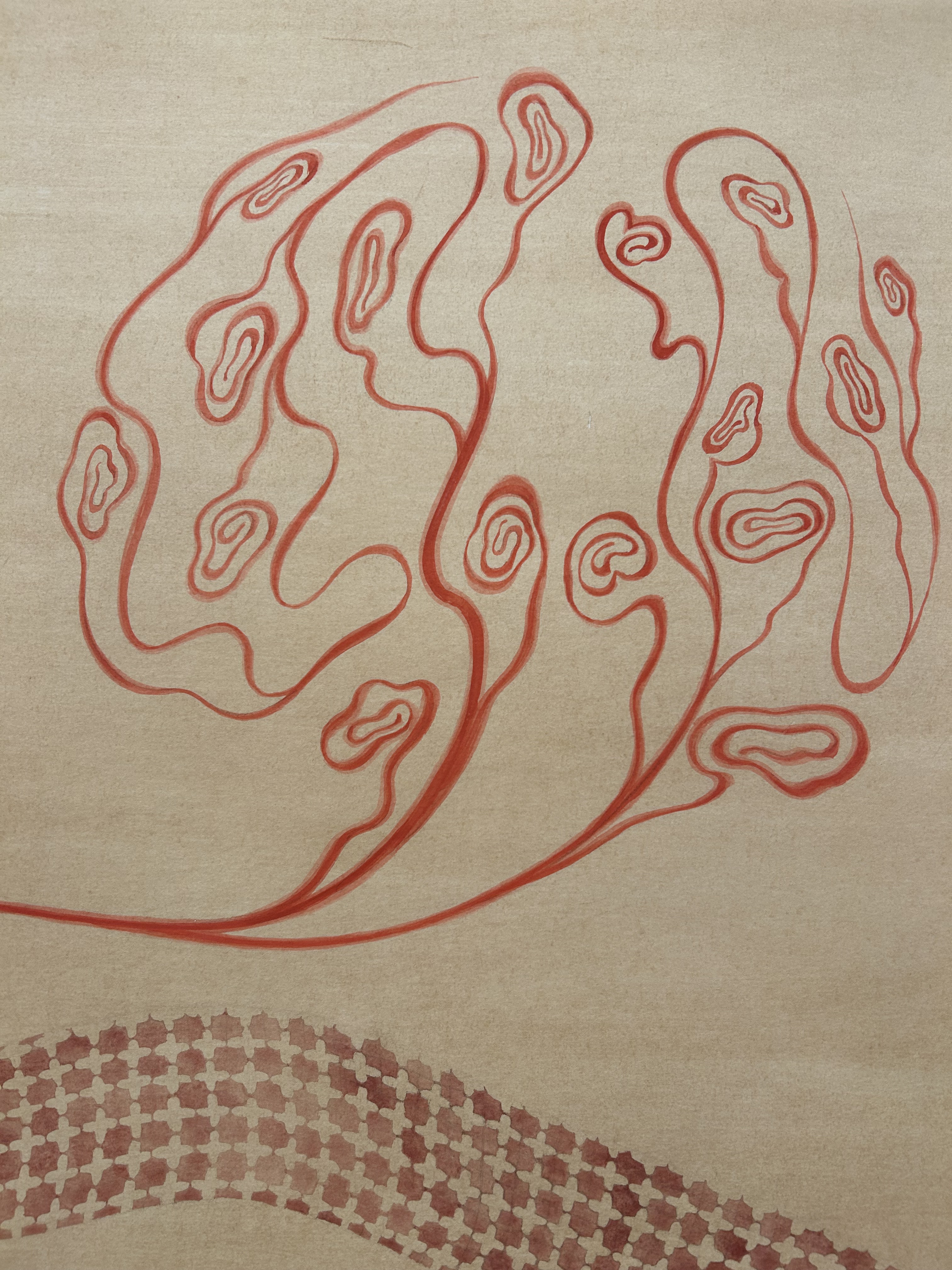
Funneling from the mouth are curling wisps of red. It’s a soggy red, traced over a second time by a darker line, menstrual in colour, ending in ovarian shapes. That is, the figure speaks as if her words were life-giving blood. The title of the painting is Birth is a Bloodsport (2024). And yet, what she has birthed is a tiny globe, cupped in her hand, an ornament rather than a sentient being.


Though to be sure, she herself is not quite human. The body is definitively female and fleshy, but there’s something cyborg about it, too, perhaps because of the ornament, or perhaps because of a bulbous topknot growing rigidly from the head. She is familiar and she is foreign. Indeed, her in-betweenness is like that of the figures in two companion paintings mounted nearby titled Clacker (2024) and Cloaked Figure (2024). One is draped in lapis-blue fur pulled back to reveal her smooth vulva and legs. She wears a skull cap topped with cottony balls and nail guards (the clackers?) on her toes. She has elegant gold fangs. The other’s body is indistinguishable under a blue cloak, except for horned bird feet. Cottony balls here are in the shape of a fir atop her hairless head, repeated below in the pattern on a gourd shape leashed to her clasped hands. Her eyes dangle from a string like tiny gold beads.


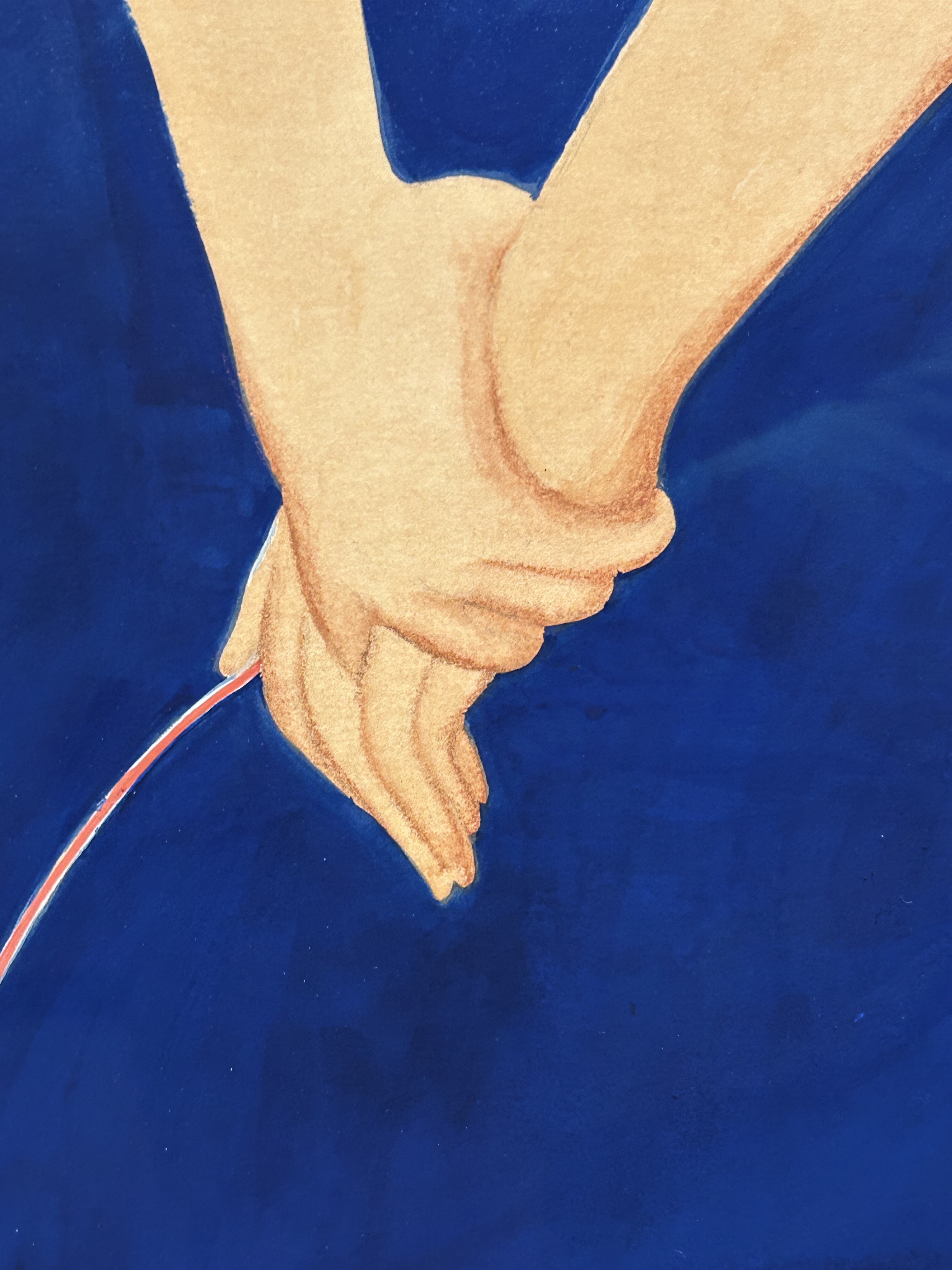

The artist says she is inspired by science fiction. There is something to that. The figures are not of this world. There is something monstrous about them. Still, the materials of making––the rich colours and patterns on the tea-stained paper surfaces––celebrate the lived reality of the female form. They adorn the body; they make it visible. Yet there is a paradox, since it is this dimension of the paintings––this performance of the artist’s Sri Lankan identity––that also calls into question female nudity as representation. It makes the figures increasingly unfamiliar and strange, almost transforming them into total aliens, but not quite getting there. It questions the politics of picturing the female form.
The spaces that the artist’s figures occupy also become increasingly uncanny. Materiality is laminated to dream. Partly this is accomplished by layering shadows with images. For instance, a large mural-sized painting titled I Couldn’t Wait Longer (2023) is tilted away from its supporting wall, forming a literal wedge of space. On that wall is a coloured shadow––turmeric yellow, tamarind red, cardamon green––created by light hitting the open weave of the painted polyester gauze. You can see behind and through the painting, in other words. It is a permeable surface. It doubles.


The space of the image, too, is multiple. Acrylic gouache soaks inwards, wet on the tea-coloured threads composing the ground (traced by a ghostly white design, nearly invisible). The picture also grows outwards, in the opposite direction, through clusters of clay beads and flowers drifting between the figures’ ankles, wrists, thighs. Scattered gently over the surface are tiny white beads which, along with embroidered gold-wrapped thread, catch at the gallery light and reflect it back, adding dimension to the pictorial space.


The painted figures themselves are in-between. They are female, heavy-breasted, with long dark hair flying up and over the edge of the painting. They are masked as a leopard, water buffalo, and round-eyed harlequin. They float gravity free.
The strangeness of the pictures (female or multi-species figures, inchoate spaces) straight away brings to mind writer Amitav Ghosh’s observations about science fiction in The Great Derangement: Climate change and the unthinkable (like Perera, Ghosh considers Sri Lanka to be one of his homes). He reflects on the near impossibility of writing stories about climate catastrophes,
Indeed, it could even be said that fiction that deals with climate change is almost by definition not of the kind that is taken seriously by serious literary journals: the mere mention of the subject is often enough to relegate a novel or a short story to the genre of science fiction. It is as though in the literary imagination climate change were somehow akin to extraterrestrials or interplanetary travel. (p 7)
He goes on to observe that there can be something so piercingly true and so physically overwhelming about climate change that it is as if it cannot be articulated in fictional or even nonfictional prose. And yet, the urgency of keeping that catastrophe real, in this world, is paramount.
Perera’s artwork tugs us towards science fiction. And she is more deliberate in her intentions. But the greater challenge, to me, is thinking about her work otherwise, as fiction about who we are now, in this moment. It is a fiction that is about the increasingly tenuous connection of the more-than-human to the human, and the ways that we make up culture as we go along, always remaining in sight of her focus on artmaking as a mode of feminist agency and imagination in an increasingly fascist world.
Artworks:
Birth is a Bloodsport. 2024. Tea, red oxide pigment, acrylic gouache, watercolour chalk on cotton rag paper
Clacker. 2024. Tea, acrylic gouache, gold gesso, on cotton rag paper
Cloaked Figure. 2024. Tea, acrylic gouache, gold gesso, on cotton rag paper
I Couldn’t Wait Longer. 2023. Polyester, acrylic gouache, chalk, charcoal, gel pen, gold metallic thread, polymer clay beads, glass beads, wooden beads, aluminum and wood frame
Contemporary Calgary
Rajni Perera & Marigold Santos: Efflorescence/The Way We Wake
November 21, 2024–April 6, 2025
Curated by Cheryl Sim
 staring at the ceiling