

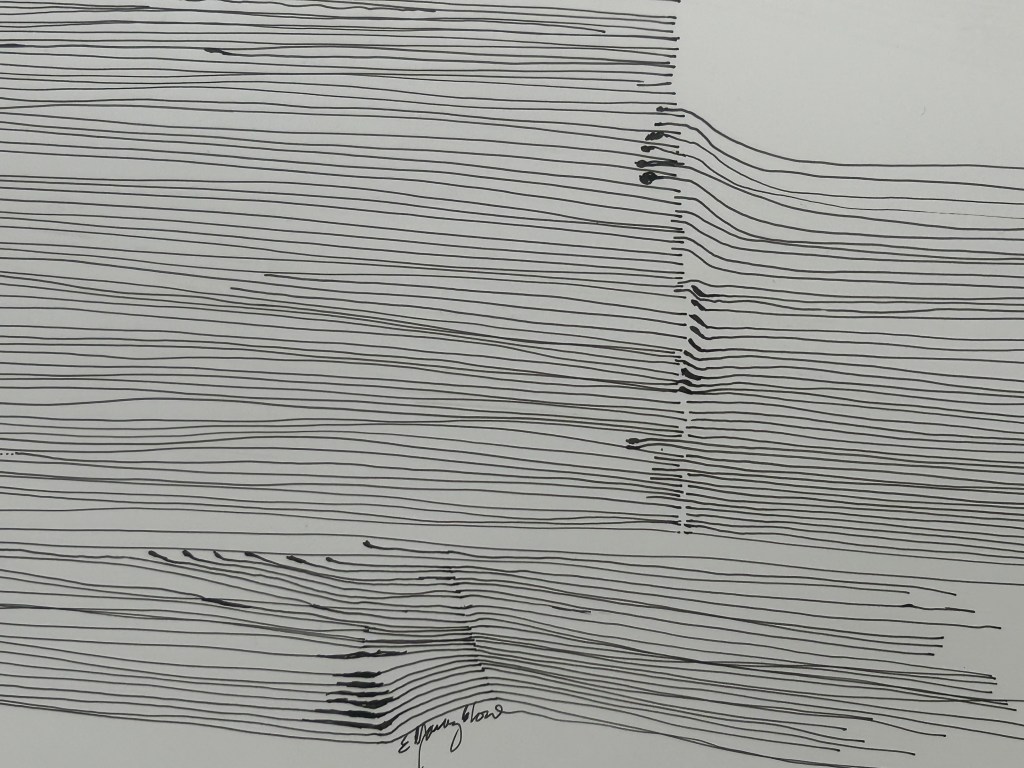

The first mark is deep. You can see the dot where the tip of the pen hit the mylar, how it stretches into a line, moves to the left, ends in a blotch. The line is thin, tensile, uneven. It never crosses other lines, but is never regular, either. It is performative; the artist’s hand given visibility.
Titled An Investigation (2010), the artist Elizabeth Youngblood has created an image that looks something like the geological lineation of rock or a seismograph of tectonic plates buckling and pushing against each other, an image that evokes land and mass. That it is rendered on a soft skin-like surface which glows beneath the gallery pot lights brings it out of the realm of science, though, as does the trace of the performance itself. There is something deeply personal and bodily about this investigation.
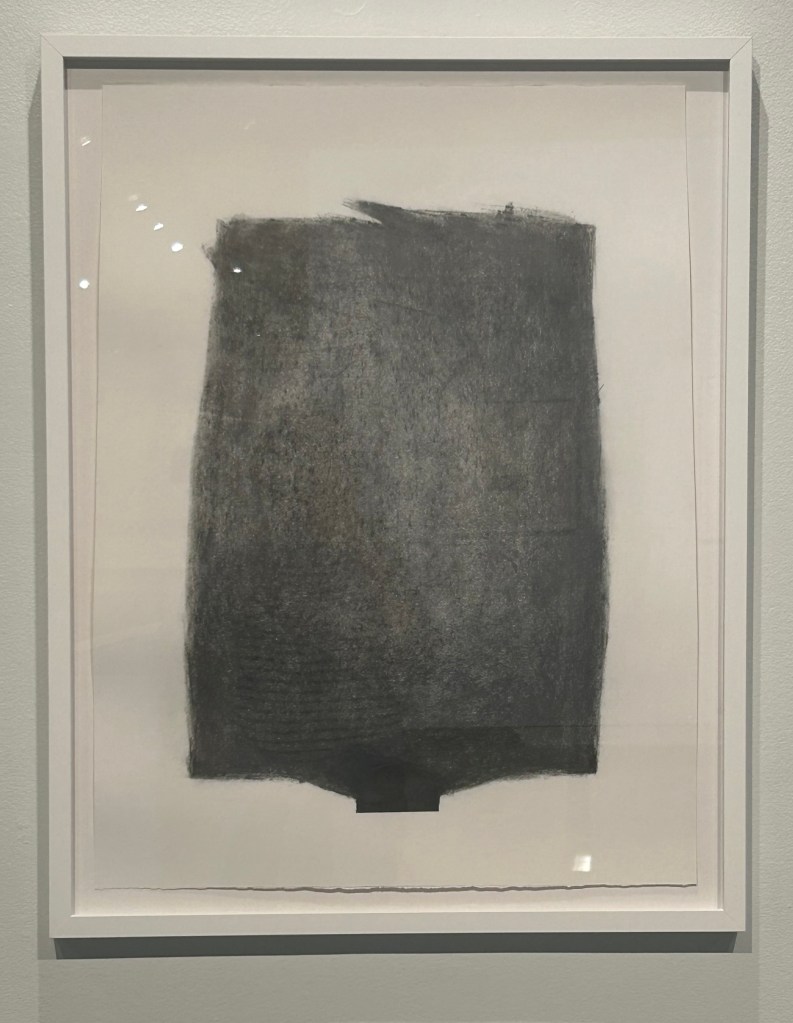
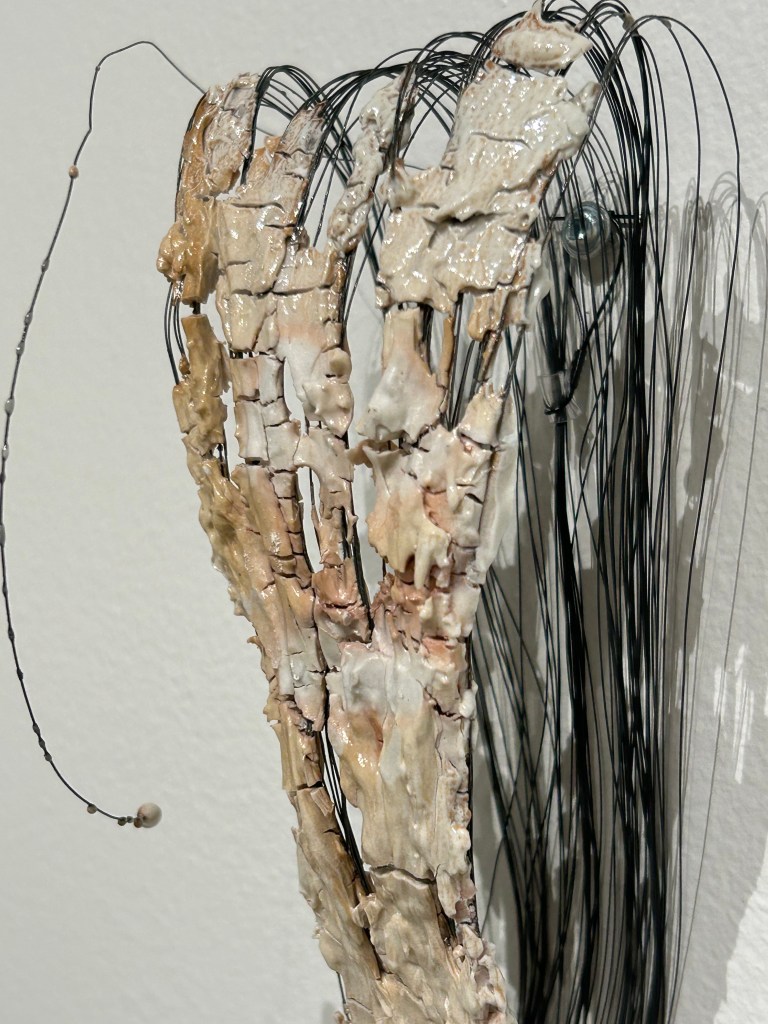
There are similarly intimate breaking points, tipping points, disruptions, perturbations of the lines we use to demarcate our lives in many of the artworks on display: an homage to a sewing teacher that treats line as if thread, but insists on its own inky materiality in more of those blotches, now magnified in size; the wires in the shape of a burden basket, but encrusted with boney salt-fired porcelain; the lines giving texture to the rubbed-on form of what the artist calls a “primordial basket,” but submerged.


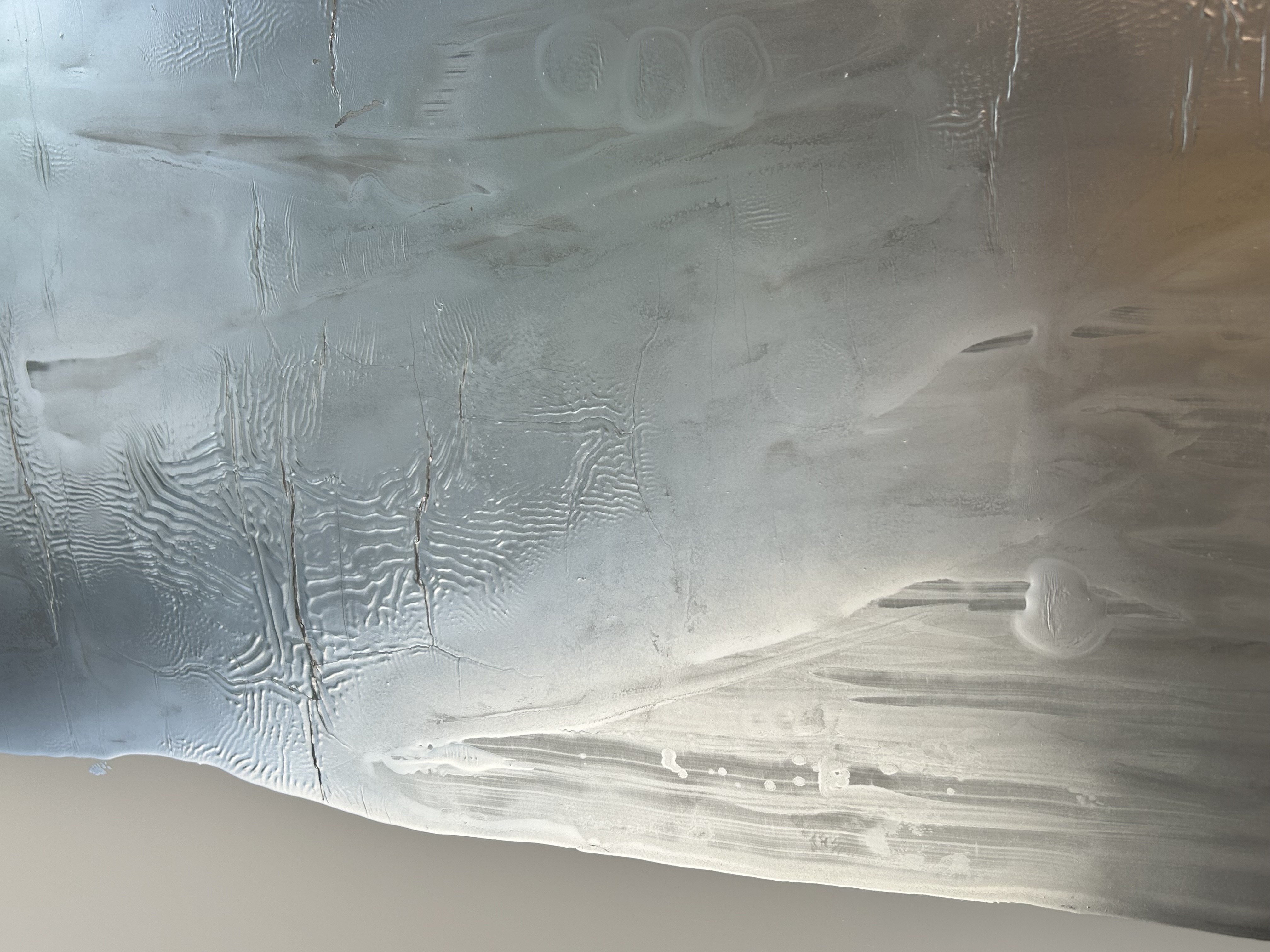
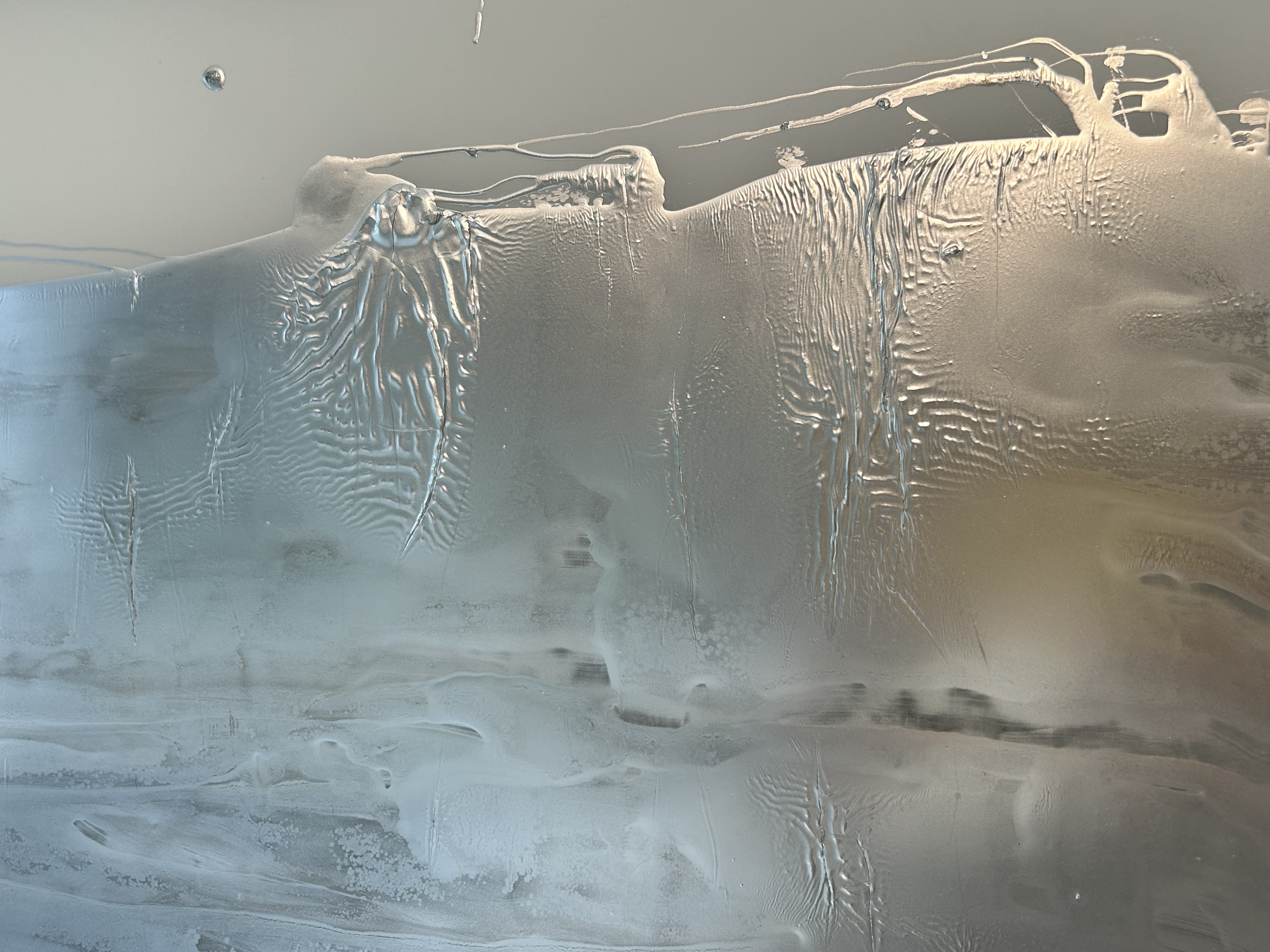
Where line disappears entirely, the performing hand imprinting itself onto a surface still exists. A magnificent untitled painting (2019) is composed of thickly applied silver paint over a passage of graphite that has been pushed into the mylar. Applied is not precisely the right word, though. The surface is sculptural, built up, an exploration into the chromatic range of silver. There are marks (lines, again) that look like fingerprints or palm prints, yet the sense is that the pigment was allowed to pool on the surface, that the artist was working with the painted surface rather than on it. There’s a softness to it.
In the back of the gallery there is a case featuring Youngblood’s print designs for the Detroit Symphony Orchestra, the New York Times, her own studio. She likes micrographia. The case feels like it confirms the meaning of everything else in the show. It demonstrates a syntax that we all understand and enter into when we learn language and participate in literary and mainstream culture; the rest of the work, in contrast, is the artist’s singular voice questioning and commenting on that syntax, and providing us with a vision of how we can be true to ourselves in the world.
Elizabeth Youngblood, Syntax
Curated by Srimoyee Mitra
July 21–August 3, 2024
Stamps Gallery
201 S. Division Street
Ann Arbor, Michigan
An Investigation, 2010
Ink on mylar
Homage to my first sewing teacher, 2007
Ink on paper
#2, 2013
Salt-fired porcelain, wire
Primordial basket, 2022
Graphite on paper
Untitled Silver and Graphite, 2019
Silver paint, graphite on paper
 staring at the ceiling