

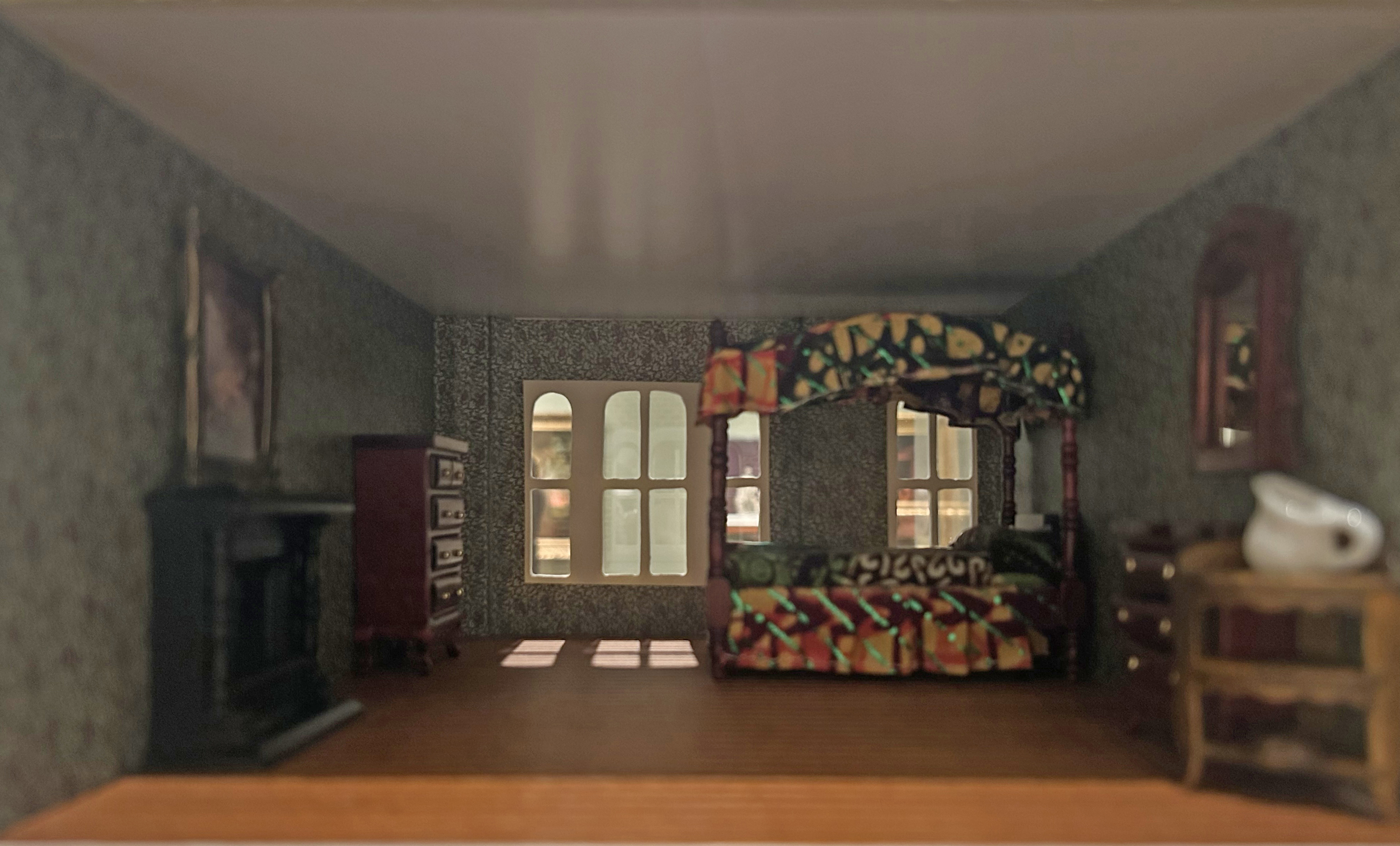

The window is about the width of an eye. On the other side, you can dimly make out carved wooden bedposts and a canopy bed covered with Ankara cloth wax-printed in turquoise, yellow, and white.
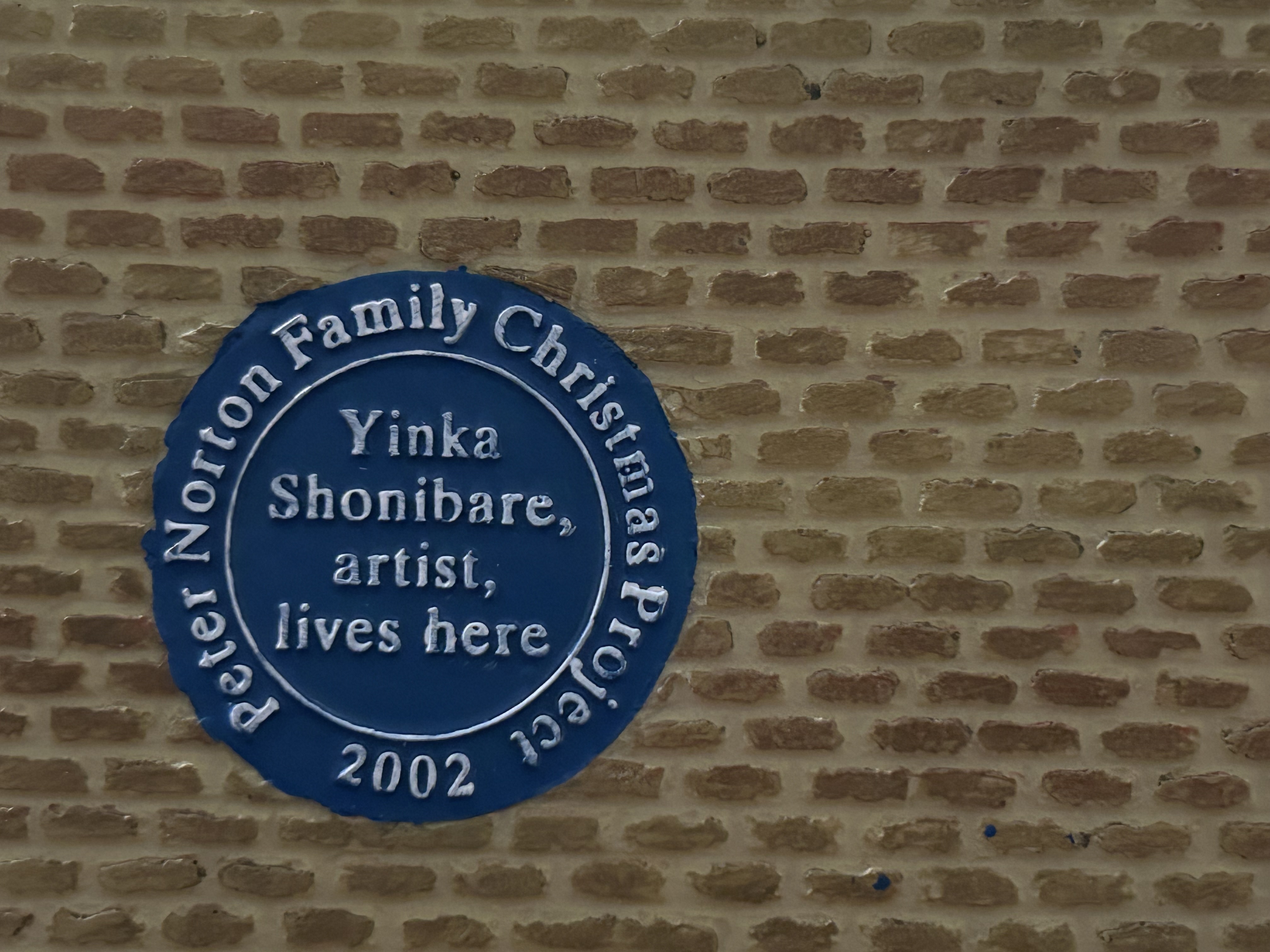
The dollhouse is a tiny replica of a home in which the artist Yinka Shonibare lived in London’s East End. He created it as part of the Peter Norton Family Christmas project in 2002, and it does have a Christmassy feel to it, in that Dickens’ sense: the sturdiness of the brick-clad exterior and high white window frames of a nineteenth-century terrace house, the smoothly polished miniature furnishings, that anticipation of finding fresh new details as you crouch to see what’s inside. It’s very Victorian. Which is to say, it’s very colonial: the world made small, made for gifting and collecting, and for play, where the details are integrated into a larger design. And everything is visible.
If such a vision of Christmas speaks to the darkness of Victorian (Christian) imperialism, still, there are disruptions to it. That Ankara cloth, for one. It’s colourful, vibrant against the dark oak furniture. The cloth is the creation of Dutch trading companies that found a thriving market in West Africa during the nineteenth-century for their imitation Indonesian wax-print batiks (Indonesia was a Dutch colony at the time). It is and is not African.


Inside, there’s a print from Shonibare’s Diary of a Victorian Dandy project hanging on the wall, in a fake gilt frame just as it would be displayed in human size. The dandy is a figure of wit, style, often queer or asexual. Shonibare has described his attraction to the dandy as an “outsider [who] upsets the social order of things.” The V&A curators write:
Shonibare’s identification with the dandy as an outsider or foreigner who uses his flamboyance, wit and style to penetrate the highest levels of society, which would otherwise be closed to him. Much of Shonibare’s work engages with his ‘outsider’ status as a black, disabled artist and investigates conditions of postcolonialism and globalisation.
But is that truly the case? The violence and inhumanity of colonialism is very much alive today. If postcolonialism is a reflection on our colonial past, we must admit that it fails to fully grapple with our colonial present. We do not live in a post-colonial world. The question that Shonibare raises in Dollhouse, directed at those of us for whom the brutality of colonial realities appears to be distant, is how and where to find those tiny disruptions, those images and things, that wake us to the realities of being imprisoned inside politically totalizing structures (it is a house, after all), and affirm a transnational, feminist, and cultural resistance.
Yinka Shonibare
Untitled (Dollhouse); from the 2002 Peter Norton Family Christmas Project
resin, plastic, wood, paper and fabric
13 in x 7 ⅞ in x 10 ¼ in (33.02 cm x 20 cm x 26.04 cm)
University of Michigan Museum of Art
Yinka Shonibare
Diary of a Victorian Dandy: 14.00 hours
Photograph
2012 (printed), 1998 (photographed)
Victoria & Albert Museum
National Museum of African Art, Washington, DC
Victoria & Albert Museum, London
 staring at the ceiling