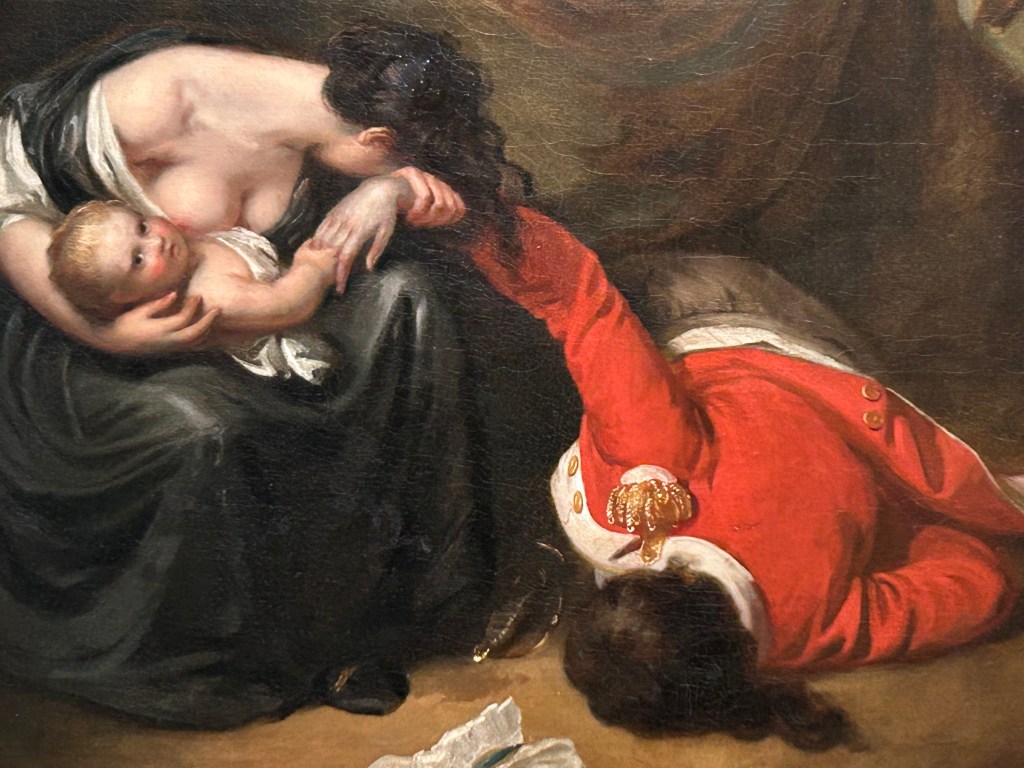
Three hands form a chain. One hand onto which other hands cling is pale, threaded with green veins. It shimmers against fleshy reds and yellows, darkened cloth draped over a knee, and the burnished hair of a woman bent over, holding on, and cradling a baby. The body at her feet is rolled onto one shoulder, identifiable as a British cavalryman by his red coat, epaulets, sabre, and the fires of war burning in the distance. He is dead.

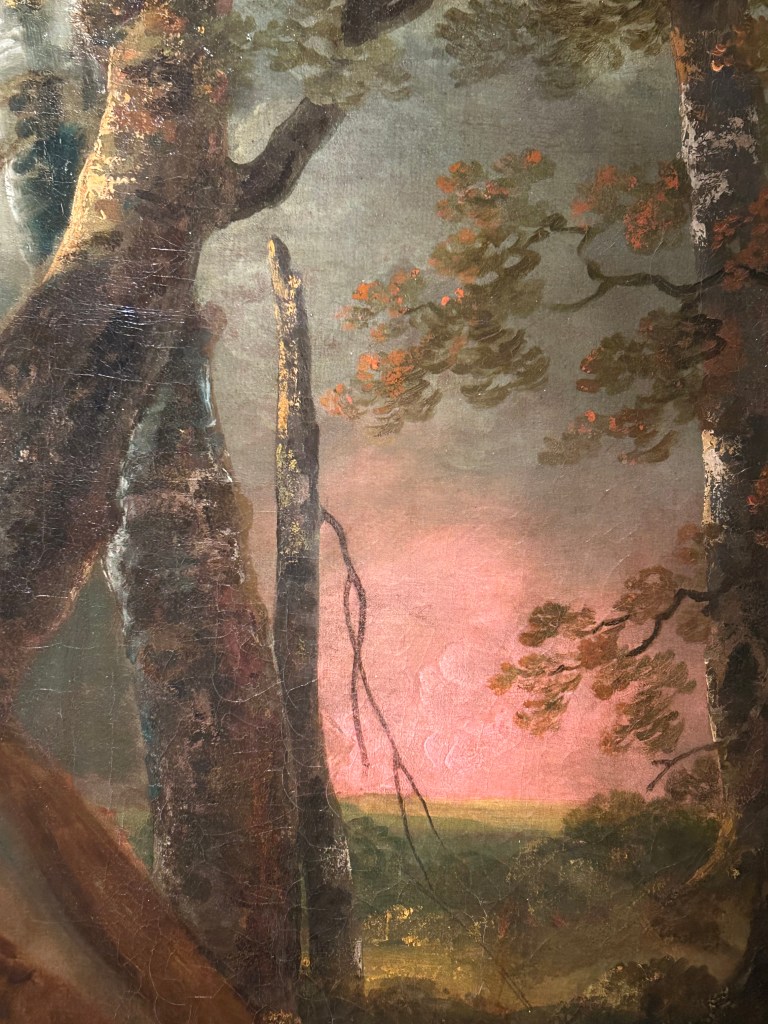
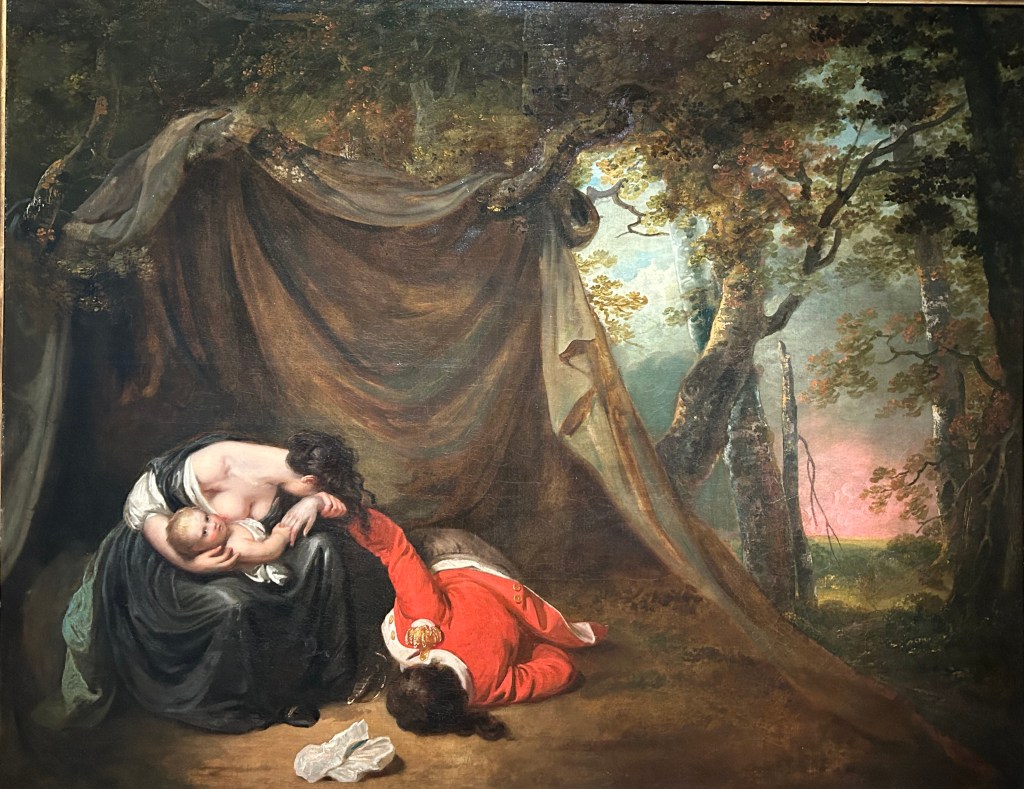
When the painting was first exhibited in London in 1789, a few years after the British were defeated in the American revolution, the public response was emotion-charged. As the Museum of the American Revolution puts it:
People who saw English artist Joseph Wright’s The Dead Soldier on exhibit…were moved to tears. Wright’s painting reflects how the British struggled to cope with the wartime violence of the late 1700s, particularly in the wake of the American Revolutionary War. Thousands of British husbands, sons, and fathers suffered wounds or death for their nation. Wives became widows. Children became orphans. The Dead Soldier visualizes the personal cost of war and revolution.
Yet exhibition visitors as well as the curators who wrote this label got it almost precisely wrong. This is not a painting about war. It is a painting about the representation of war. And even more than that, it is a painting about fakery in the representation of war.
Take, for instance, the brown tent curtain slung over tree branches framing the three figures, something like the curtains you’d see at a theatre. It imparts drama (and fiction) to the scene. And it is a scene, a tableau vivant, the figures silently posed in exaggerated positions of anguish and exposure. They give themselves up to the beholder’s gaze easily––with the exception of the infant. His stony gaze, locked onto that of the beholder, calls into question the very act of gazing at the picture, that shiver of sentimentality at encountering the anonymous (and perfectly clean and tidy) dead soldier and the woman’s tragic expression of grief, or equally, the scopic pleasures of matching the colour and shape of the child’s cheeks to his mother’s rounded nipples.
Keep in mind that Wright was far from a sentimental artist. It is the staginess of the picture that Wright is interested in, in a brainy way, meaning that his interest lies in the ways that images of war are manipulated and idealized. I am not a historian of early modern England, but I suspect that representations of the imperial British army battling the settler-colonists in North America in the press and broadsides dating to Wright’s lifetime were very much in a romantic vein. In that sense, the painting is a warning against the politics of representing war.
In the States we are constantly being told by the Biden administration that what we see in photographs of dead Palestinian bodies and destroyed buildings in Gaza is not happening. The propaganda can’t keep up with the flow of images. And these are terrible images, raw images of toddlers buried in dusty rubble, mothers holding onto wrapped corpses of their children, blood streaming over faces of the men and women searching for survivors of the IDF onslaught. Wright, along with those of us who see the human costs of such fakery, would have despaired.
The Dead Soldier
Painted by Joseph Wright of Derby
ca. 1789
Oil on Canvas
See Wright’s painting in the exhibition Unsettling Histories: Legacies of Slavery and Colonialism @ umma. Curated by Ozi Uduma, Assistant Curator of Global Contemporary Art
February 21, 2026 addendum
I published this post in June 2024, twenty-one months ago. The genocide continues, and the tragedy that the people of Palestine have been made to endure seems to have vanished from the eyes and hearts of the public here in Canada, as if it never happened, as if it is not real.
This past week I was in the Bay area to do research for a book of stories I am writing about streetlife in Beijing a century ago. While there, I visited the Legion of Honor Museum to see the Manet & Morisot exhibition––rather, to see two of Manet’s paintings, the amazing Le Balcon (The Balcony) and an old friend, Le Chemin de fer (The Railway). I was surprised to find on permanent display a “copy” that Wright had made of The Dead Soldier the same year it was created. The curators noted that it was a representation of the poem “The Country Justice” by John Langhorne.
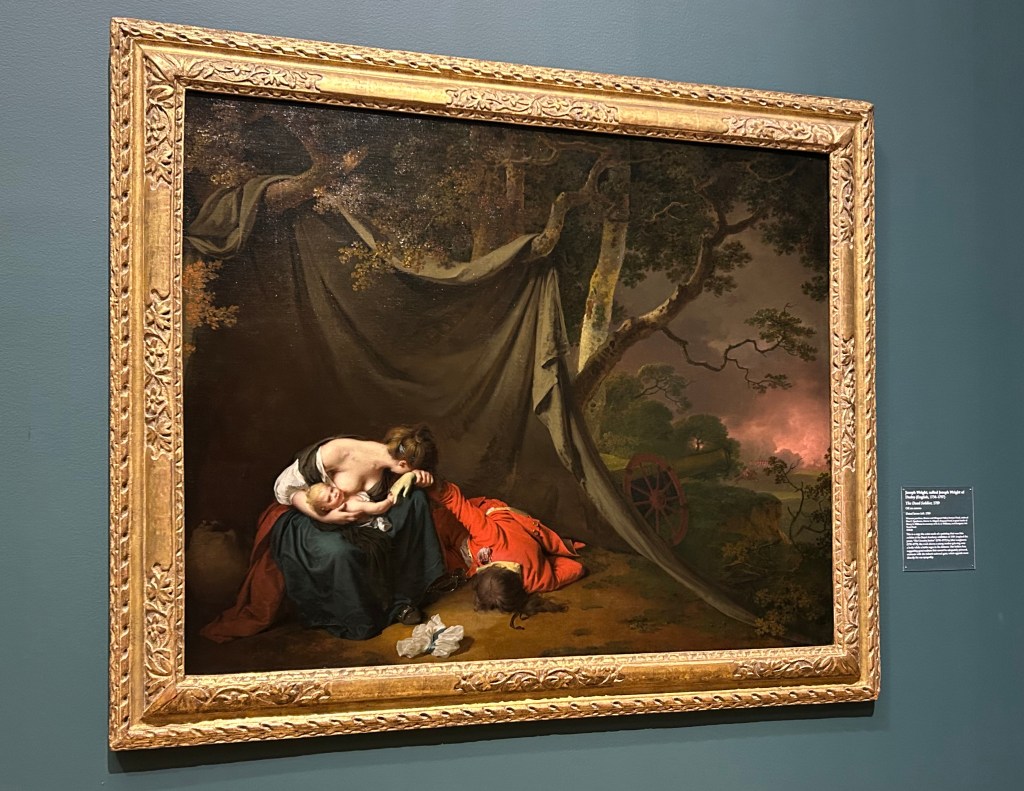
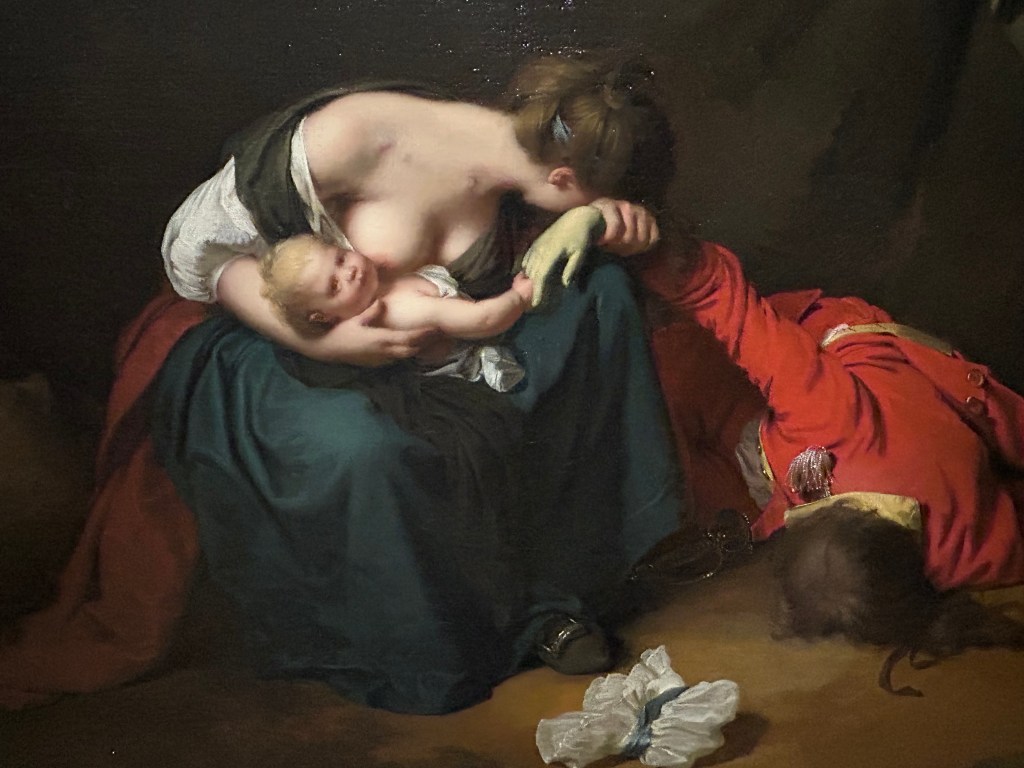
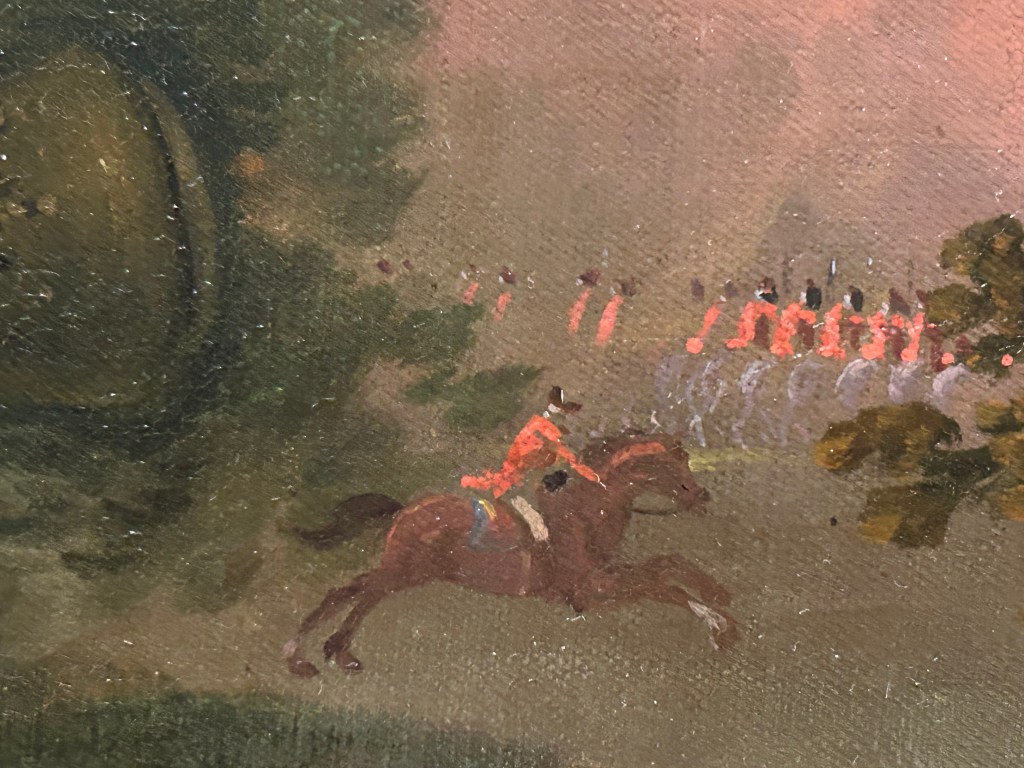
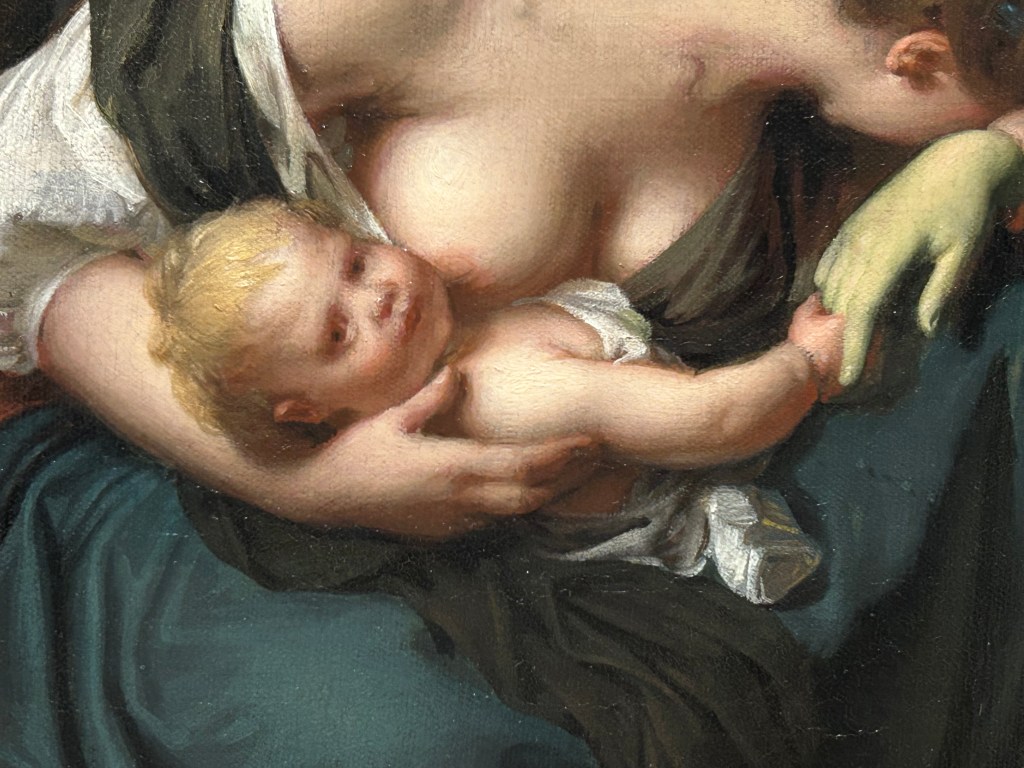
It’s an interesting painting for being so far from the original yet also a “copy.” It insists on the brutality of war in a far more literal way: the hand of the dead soldier is a putrid green; the soldiers in the distance can be counted. The infant is an infant––softer, rounder, pinker, and with a less penetrating, slightly unfocused gaze, as if the drama surrounding him is not visible to him, or he is not aware of it.
Encountering the painting through the lens of the continuing genocide, I can’t help but think that I was right in my original interpretation: this “copy” shows us Wright not celebrating or documenting his success at the 1789 exhibition, as a pure copy might possibly do, but acknowledging his failure to actually make any real and lasting change to how we picture war.
 staring at the ceiling